
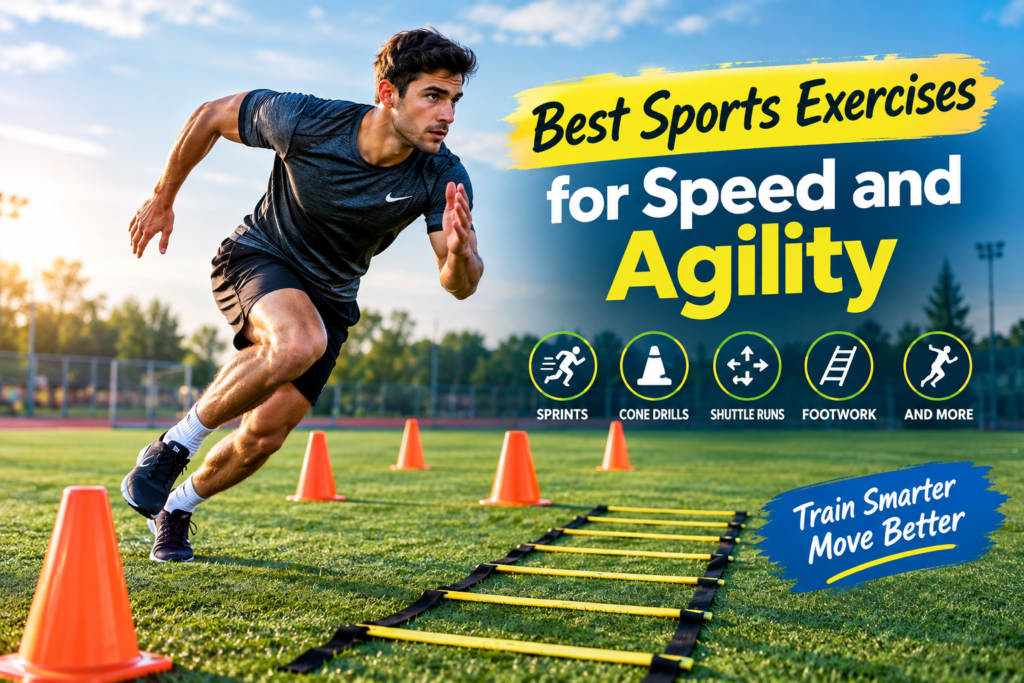
Speed and agility are important skills in almost every sport. Whether you play football, cricket, basketball, tennis, baseball, or another sport, being able to move quickly, change direction, and maintain balance can help you perform better on the field or court.
The good news is that speed and agility can be improved with regular training. You do not always need expensive equipment or a professional gym. Many effective speed and agility exercises can be performed with simple equipment or even just your own body weight.
In this guide, we will look at the best sports exercises for speed and agility, how they work, how to structure your training, and common mistakes to avoid.
What Are Speed and Agility?
Before starting an exercise program, it helps to understand the difference between speed and agility.
Speed is your ability to move quickly from one point to another. For example, a football player sprinting toward the ball uses speed.
Agility is your ability to quickly change direction while maintaining control and balance. A basketball player changing direction to defend an opponent is using agility.
Although speed and agility are different, they work together in many sports.
Training both qualities can help athletes improve:
- Quickness
- Balance
- Coordination
- Reaction time
- Acceleration
- Change-of-direction ability
- Movement control
- Overall athletic performance
Why Speed and Agility Training Is Important
Sports often require athletes to react quickly. You may need to sprint, stop, turn, jump, or accelerate within a few seconds.
Regular speed and agility training can help you become more comfortable with these movements.
It can also make training more varied and enjoyable. Instead of doing only traditional workouts, you can include short sprints, footwork drills, lateral movements, and reaction exercises.
For beginners, the goal should not be to move as fast as possible immediately. Good technique and controlled movement should come first.
1. Short Sprints
Short sprints are one of the simplest ways to train acceleration and speed.
You can perform them on a field, track, court, or another safe open surface.
How to do short sprints
- Start with a comfortable standing position.
- Keep your body relaxed.
- Accelerate quickly for a short distance.
- Maintain good posture while running.
- Slow down gradually after reaching the finish point.
- Rest before repeating.
For beginners, several short repetitions are usually more useful than trying to run one extremely long sprint.
Why short sprints help
Short sprints focus on acceleration, which is important in sports where players frequently need to reach the ball or change positions quickly.
2. Shuttle Runs
Shuttle runs are excellent for combining speed with changes of direction.
Place two markers a short distance apart. Run from one marker to the other, turn under control, and return.
How to perform shuttle runs
- Start behind one marker.
- Sprint toward the second marker.
- Slow down before turning.
- Change direction safely.
- Accelerate back toward the starting point.
- Rest and repeat.
Shuttle runs can be useful for football, basketball, cricket, tennis, and many other sports.
3. Lateral Shuffles
Lateral movement is an important part of agility.
Lateral shuffles teach your body to move quickly from side to side while maintaining control.
Steps
- Stand with your feet approximately shoulder-width apart.
- Bend your knees slightly.
- Keep your chest controlled and your eyes forward.
- Move sideways using quick steps.
- Avoid crossing your feet during basic lateral shuffles.
- Repeat in the opposite direction.
This exercise can be particularly useful for athletes who need to defend, react, or move sideways during competition.
4. High Knees
High knees are a simple bodyweight exercise that can help develop coordination and quick leg movement.
How to perform high knees
Stand tall and begin moving your knees upward in an alternating rhythm. Keep your upper body controlled and use your arms naturally.
Start slowly if you are new to the exercise. As your coordination improves, you can gradually increase the pace.
High knees can be used as part of a warm-up or included in a speed-focused workout.
5. Butt Kicks
Butt kicks are another simple movement drill that can be used during warm-ups.
Jog in place or move forward while bringing your heels toward the back of your body.
The exercise encourages quick leg movement and can help prepare your body for more demanding activity.
Remember that warm-up exercises should be controlled rather than exhausting.
6. Cone Drills
Cone drills are popular in sports training because they allow athletes to practice changing direction.
You can arrange several cones in different patterns, such as a straight line, zigzag, square, or T-shape.
Example cone drill
Set up four markers in a square.
- Start at one corner.
- Move forward toward the next marker.
- Shuffle sideways.
- Move backward when appropriate.
- Return to the starting point.
The exact pattern can be adjusted according to your sport and training level.
7. Zigzag Runs
Zigzag running is another effective way to practice changes of direction.
Place markers in a zigzag pattern and move between them while maintaining control.
The key is not simply to run as fast as possible. Focus on:
- Controlled turns
- Balanced foot placement
- Quick acceleration
- Good posture
- Looking ahead
As your technique improves, you can gradually increase your speed.
8. Ladder Footwork Drills
An agility ladder can be useful for practicing footwork and coordination.
You can perform patterns such as:
- One foot in each space
- Two feet in each space
- Side steps
- In-and-out steps
- Forward and backward movements
If you do not have an agility ladder, you can create a simple visual pattern on the ground using safe markers.
The main purpose is to practice controlled and coordinated foot movement.
9. Box Drills
Box drills combine forward, sideways, and backward movement.
Set up four markers to create a square.
Move around the square using different movement patterns.
For example, you might sprint forward, shuffle sideways, move backward, and then return to the starting position.
Box drills are useful because they train multiple directions instead of focusing only on forward running.
10. Reaction Drills
Speed is not only about how quickly you can run. Reaction speed is also important.
Reaction drills require you to respond to a visual or verbal signal.
For example, a training partner can call out a direction, and you move toward the appropriate marker.
You can also use different numbers or signals for different movements.
These drills can help athletes practice reacting instead of simply following a predictable pattern.
11. Jump Rope
Jumping rope can be a useful addition to sports conditioning.
It requires rhythm, coordination, and repeated foot movement.
Beginners should start with short periods and focus on maintaining a comfortable rhythm.
As coordination improves, you can experiment with different foot patterns.
Jump rope training can complement other speed and agility exercises, but it should not replace sport-specific practice.
12. Skipping Drills
Skipping is a simple movement that can improve rhythm, coordination, and lower-body control.
You can perform basic skipping forward or use different variations depending on your experience.
Keep your movements controlled and avoid trying complicated variations before you are comfortable with the basic movement.
13. Single-Leg Balance Exercises
Agility requires more than quick movement. You also need to control your body when moving, stopping, and changing direction.
Single-leg balance exercises can help you practice stability.
Basic single-leg balance
- Stand on one leg.
- Keep your body upright.
- Maintain balance for a comfortable period.
- Switch legs.
- Repeat.
For an added challenge, you can perform controlled movements while maintaining balance.
14. Squat-to-Stand Movements
Strong legs can support athletic movement.
A controlled squat-to-stand movement trains the muscles used for many everyday and sporting actions.
Keep your movement comfortable and focus on proper technique.
Avoid rushing through repetitions. Quality movement is more important than simply completing a large number of repetitions.
15. Reverse Lunges
Reverse lunges are another useful lower-body exercise.
Step backward with one leg and lower your body in a controlled way. Return to the starting position and repeat on the other side.
They can help develop lower-body strength and coordination, which are useful foundations for speed and agility training.
16. Lateral Lunges
Many sports require movement from side to side, making lateral exercises valuable.
For a lateral lunge, step to one side while keeping control of your body. Bend the moving leg while the other leg remains more extended, then return to the starting position.
Start with a comfortable range of motion and focus on balance.
17. Acceleration and Deceleration Drills
Being able to accelerate is useful, but athletes also need to slow down safely.
Acceleration and deceleration drills teach you to transition between faster and slower movement.
For example:
- Start with a controlled jog.
- Accelerate for a short distance.
- Gradually slow down.
- Rest.
- Repeat.
Do not ignore the stopping part of the drill. Controlled deceleration is an important part of athletic movement.
18. T-Drill
The T-drill is a classic agility exercise.
Place four markers in a T-shaped pattern.
The athlete moves forward, then laterally across the top of the T before returning through the center.
The drill can be performed at different speeds depending on experience.
Because it combines forward and lateral movement, it can be useful for athletes who participate in sports requiring frequent direction changes.
19. 5-10-5 Shuttle Drill
The 5-10-5 shuttle, sometimes called a pro agility drill, involves rapid movement in multiple directions.
It requires an athlete to accelerate, stop, change direction, and accelerate again.
Beginners should focus on technique before worrying about completing the drill as quickly as possible.
Make sure the training surface is suitable and that you have enough space to move safely.
20. Sport-Specific Agility Training
One of the best ways to improve athletic movement is to practice movements that resemble your sport.
For example:
Football:
Practice short sprints, lateral movements, changes of direction, and reaction drills.
Cricket:
Focus on quick acceleration, short-distance running, turning, and fielding-related movement.
Basketball:
Practice defensive slides, short sprints, stops, and changes of direction.
Tennis:
Focus on lateral movement, quick recovery steps, and short bursts.
Baseball:
Practice acceleration, quick reactions, and directional changes.
Sport-specific training can help connect general fitness with the actual movements used during competition.
How Often Should You Train Speed and Agility?
The ideal training schedule depends on your age, experience, sport, overall activity level, and recovery.
Beginners can start with a small amount of speed and agility work and gradually increase their training.
A simple weekly approach might include:
- Day 1: Speed and agility training
- Day 2: Easy activity or recovery
- Day 3: Strength and coordination
- Day 4: Rest or light activity
- Day 5: Speed and agility training
- Day 6: Sport practice
- Day 7: Rest
You do not need to follow this exact schedule. Your training should fit your sport and personal circumstances.
How to Create a Simple Speed and Agility Workout
A beginner workout can be structured around a warm-up, movement drills, and recovery.
Step 1: Warm up
Spend several minutes preparing your body with easy movement and dynamic exercises.
Step 2: Start with technique
Practice movements such as lateral shuffles, high knees, or controlled cone drills.
Step 3: Add short speed work
Include short sprints or shuttle runs with adequate rest.
Step 4: Practice direction changes
Use cone drills, box drills, or zigzag runs.
Step 5: Cool down
Finish with easy movement and allow your breathing to gradually return toward normal.
Tips for Improving Speed and Agility
1. Focus on Technique
Moving faster does not automatically mean moving better.
Learn the movement first, then gradually increase speed.
2. Train Consistently
A few weeks of consistent practice can be more useful than one extremely difficult workout.
3. Allow Recovery
Your body needs time to recover from demanding training.
Avoid doing hard speed sessions every day.
4. Strengthen Your Foundation
Strength, coordination, balance, and mobility can all contribute to better athletic movement.
5. Use Different Directions
Do not train only forward movement.
Include lateral, backward, diagonal, and change-of-direction drills when appropriate.
6. Keep Sessions Focused
Speed training is generally more effective when you can maintain good technique.
When you become extremely tired, your movement quality may decline. Take appropriate rest between demanding repetitions.
7. Choose a Suitable Surface
Train on a safe, stable surface appropriate for the exercise.
Avoid practicing fast direction changes on slippery or unsuitable surfaces.
Common Speed and Agility Training Mistakes
Even simple exercises can become less effective when performed incorrectly.
Training too hard too soon
Beginners sometimes try to perform advanced drills at maximum speed immediately.
Start with controlled movements and progress gradually.
Skipping the warm-up
A proper warm-up prepares you for more demanding movement.
Ignoring technique
Poor movement patterns can reduce the quality of training.
Doing too much volume
More repetitions are not always better.
Speed and agility work should be balanced with recovery.
Only training in a straight line
Many sports require athletes to move sideways and change direction.
Include different movement patterns in your training.
Forgetting sport-specific practice
General agility exercises are useful, but athletes should also practice movements relevant to their sport.
Safety Tips for Speed and Agility Training
Speed and agility exercises can be physically demanding, especially when they involve sprinting and rapid changes of direction.
Keep these basic safety principles in mind:
- Warm up before intense activity.
- Use a suitable training surface.
- Wear appropriate sports footwear.
- Start with simple drills.
- Increase difficulty gradually.
- Take breaks when needed.
- Stop if you experience pain or feel unwell.
- Maintain enough space around you.
- Learn difficult exercises from a qualified coach when possible.
If you are new to sports training or have an injury or medical concern, consider getting guidance from a qualified professional before beginning demanding exercise.
Benefits of Speed and Agility Exercises for Athletes
Regularly practicing appropriate speed and agility drills may help athletes develop several useful physical skills.
These include:
- Better coordination
- Faster movement
- Improved balance
- Better body control
- More efficient changes of direction
- Improved acceleration
- Greater confidence during movement
- Better preparation for many sports
However, results depend on consistent training, recovery, technique, and the demands of your particular sport.
Frequently Asked Questions
What is the best exercise for speed?
Short sprints are one of the simplest exercises for practicing acceleration and running speed. They can be combined with other drills for a complete training program.
What exercises improve agility?
Cone drills, lateral shuffles, shuttle runs, ladder footwork, zigzag runs, and reaction drills are commonly used to practice agility.
Can I improve speed and agility at home?
Yes. Many basic exercises require little or no equipment. If you have enough safe space, you can practice footwork, high knees, lateral movements, and controlled drills at home.
How long does it take to improve agility?
Improvement varies from person to person. Consistent training, appropriate recovery, good technique, and sport-specific practice can support progress over time.
Is agility important in football?
Yes. Football players frequently accelerate, stop, change direction, and react to other players, so agility is an important part of overall athletic preparation.
Is speed training useful for cricket?
Yes. Cricket involves short bursts of movement, quick running between wickets, fielding, and rapid reactions. Speed and agility training can complement cricket-specific practice.
Should beginners do agility training?
Beginners can practice basic agility movements, but they should start with simple exercises and focus on technique and control rather than maximum speed.
Final Thoughts
Speed and agility are valuable athletic skills that can benefit players across many different sports. The best approach is not simply to run as fast as possible. Instead, combine short sprints, lateral movements, cone drills, shuttle runs, reaction exercises, balance work, and sport-specific training.
Start with basic movements, focus on technique, and gradually increase the difficulty as you become more comfortable. Most importantly, give your body enough time to recover between demanding sessions.
With consistent practice and a sensible training approach, speed and agility exercises can become an important part of your overall sports training routine.