
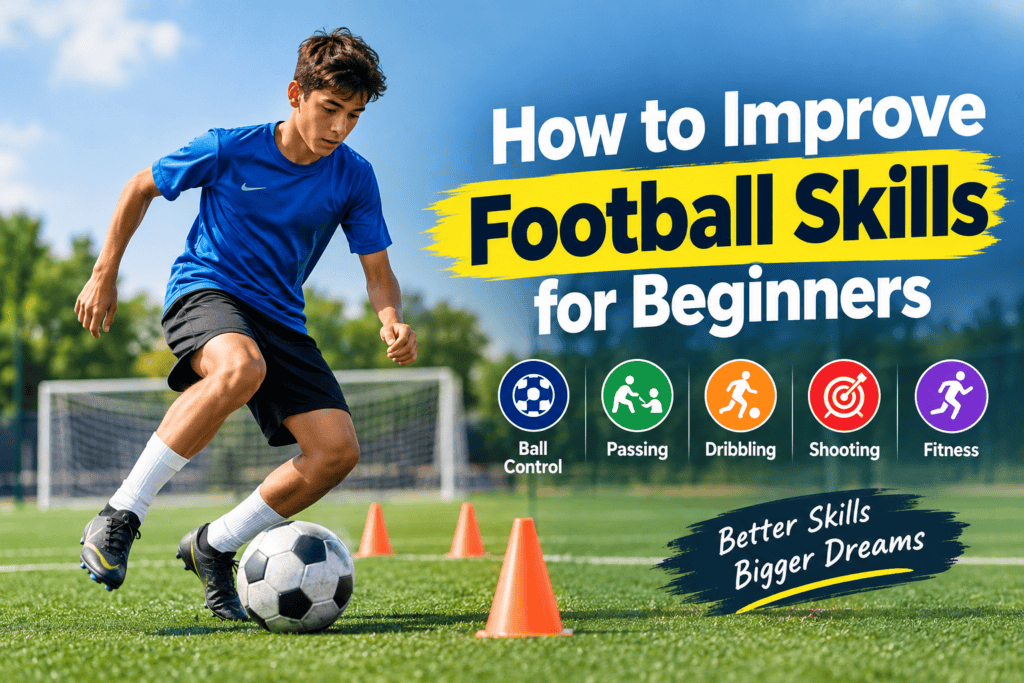
Football is one of the most popular sports in the world, and you do not need to be an expert to start improving your skills. Whether you are completely new to football or have been playing casually with friends, regular practice can help you become more confident, improve your technique, and understand the game better.
The good news is that many important football skills can be practiced almost anywhere. Ball control, passing, dribbling, shooting, movement, and fitness can all improve when you practice consistently.
In this beginner’s guide, we will explain how to improve football skills step by step and share simple training ideas that beginners can use.
Why Football Skills Matter
Football is more than simply running after the ball. Players need to control the ball, make quick decisions, pass accurately, move into space, and work with teammates.
Developing your basic skills can help you:
- Control the ball more confidently
- Make accurate passes
- Dribble past opponents
- Shoot with better technique
- Move more effectively on the field
- Make quicker decisions
- Communicate better with teammates
- Enjoy playing football more
Beginners should focus on building a strong foundation rather than trying complicated tricks immediately.
1. Start With Basic Ball Control
Ball control is one of the most important football skills for beginners.
A player who can control the ball comfortably has more time to decide what to do next. Good control also makes passing, dribbling, and shooting easier.
Start with simple exercises such as:
Ball Touches
Use both feet to make gentle touches on the ball. Try using the inside and outside of each foot.
Sole Rolls
Place your foot on top of the ball and gently roll it from side to side. This helps improve coordination.
Inside-Outside Touches
Move the ball using the inside and outside of the same foot. Begin slowly and gradually increase your speed.
Try practicing ball control for 10 to 15 minutes several times a week.
2. Practice Passing
Passing is a fundamental football skill. Even players with excellent dribbling abilities need to pass effectively during a match.
Beginners should first learn to use the inside of the foot because it provides better control and accuracy.
Find a wall or practice with a teammate. Pass the ball against the wall and control the return pass.
Focus on:
- Keeping your head up when possible
- Planting your supporting foot beside the ball
- Using the inside of your foot
- Keeping passes controlled
- Receiving the ball smoothly
As you improve, practice passing with both feet.
3. Improve Your Dribbling
Dribbling allows players to move with the ball while avoiding opponents.
You do not need complicated tricks to become a better dribbler. Good close control and changes of direction are more important for beginners.
Set up a few objects as markers and dribble around them.
Try:
- Slow dribbling
- Fast dribbling
- Inside-foot touches
- Outside-foot touches
- Direction changes
- Stop-and-go movements
Keep the ball reasonably close to your feet, especially when practicing in a small area.
4. Learn to Shoot Properly
Scoring goals is exciting, but beginners should focus on technique rather than simply kicking the ball as hard as possible.
When practicing shooting:
- Place your supporting foot beside the ball.
- Keep your eyes on the ball.
- Strike through the ball with controlled technique.
- Follow through toward your target.
- Practice accuracy before increasing power.
Practice shooting with both feet when possible.
You can also practice different situations, such as shooting after receiving a pass or taking a shot after dribbling.
5. Use Both Feet
One common mistake beginners make is relying almost entirely on their stronger foot.
Developing your weaker foot can make you more versatile on the field.
Start with simple exercises:
- Short passes with your weaker foot
- Ball touches
- Wall passes
- Controlled dribbling
- Short-distance shooting
Do not worry if your weaker foot feels uncomfortable at first. Improvement comes with repetition.
6. Improve Your First Touch
Your first touch is what you do when the ball reaches you.
A good first touch can help you move away from pressure and prepare for your next action.
Practice receiving the ball from a teammate or wall.
Try controlling the ball with:
- The inside of your foot
- The outside of your foot
- Your sole
- Your thigh when appropriate
Instead of simply stopping the ball, try directing your first touch into useful space.
7. Practice Changing Direction
Football players often need to change direction quickly.
Simple movements such as a body feint, inside cut, or outside cut can help beginners learn how to change direction while keeping control of the ball.
Place cones or other safe markers on the ground and practice moving around them.
Start slowly. Once you can maintain control, gradually increase your speed.
8. Improve Your Football Fitness
Football requires repeated movement throughout a match. Players may need to walk, jog, sprint, stop, turn, and accelerate.
Beginners can build general fitness through activities such as:
- Walking
- Jogging
- Short running intervals
- Agility exercises
- Recreational football
- Basic strength and mobility exercises
Increase training gradually and allow your body enough time to recover.
You do not need extremely difficult workouts to start improving.
9. Work on Agility and Coordination
Agility helps players change direction and react to situations on the field.
Simple coordination exercises can include:
- Quick-feet drills
- Side-to-side movement
- Short shuttle runs
- Cone drills
- Controlled direction changes
Focus on good movement and balance instead of trying to complete every drill as quickly as possible.
10. Learn How to Move Without the Ball
Football is not only about what you do when you have possession.
Good movement without the ball can create space for yourself and your teammates.
Practice:
- Moving into open space
- Supporting teammates
- Making short runs
- Changing direction
- Looking around before receiving the ball
During matches, pay attention to where your teammates and opponents are positioned.
11. Improve Your Football Decision-Making
Football is a fast game, so players often need to make decisions quickly.
Before receiving the ball, try to look around and identify available passing options.
Ask yourself:
- Where are my teammates?
- Where are the opponents?
- Is there open space?
- Should I pass, dribble, or move?
- Where should I go after passing?
Playing small-sided games can be particularly useful because players often get more touches and opportunities to make decisions.
12. Watch Football and Study the Game
Watching football can also help beginners understand the game.
Instead of watching only the player with the ball, pay attention to players away from the ball.
Look at:
- Positioning
- Passing options
- Defensive movement
- Runs into space
- Team shape
- Communication
Watching different matches can help you understand how players in different positions approach the game.
13. Practice Consistently
One of the biggest secrets to improving football skills is consistency.
Practicing for a short period regularly can be more useful than practicing once and then stopping for several weeks.
A beginner could create a simple weekly routine:
Day 1: Ball control and passing
Day 2: Dribbling and coordination
Day 3: Rest or light activity
Day 4: Passing and first touch
Day 5: Shooting and dribbling
Day 6: Practice game
Day 7: Rest and recovery
Adjust the schedule according to your age, fitness level, experience, and other activities.
14. Play With Other People
Individual training is useful, but playing with other people teaches skills that drills cannot fully reproduce.
Playing with friends or joining a local football group can help you practice:
- Passing under pressure
- Making decisions
- Defending
- Attacking
- Communication
- Positioning
- Teamwork
Small-sided games can be especially useful for beginners because players often have more opportunities to interact with the ball.
15. Learn From Your Mistakes
Making mistakes is a normal part of learning football.
You may lose the ball, miss a pass, fail to control a difficult ball, or make the wrong decision. Instead of becoming frustrated, try to understand what happened.
After training or a match, think about:
- What went well?
- What skill needs more practice?
- Which mistakes happened repeatedly?
- What can I do differently next time?
This approach can help you improve gradually.
Common Football Training Mistakes Beginners Should Avoid
Trying Too Many Tricks
Fancy skills can be fun, but beginners should first develop basic control, passing, and movement.
Practicing Only the Strong Foot
Use both feet during training whenever possible.
Ignoring Fitness
Technical skills are important, but football also requires movement and endurance.
Training Too Hard
More training does not always mean better training. Rest and recovery are important parts of development.
Focusing Only on Shooting
Shooting is important, but passing, control, movement, defending, and decision-making are also essential.
Giving Up Too Quickly
Football skills take time to develop. Improvement may happen gradually rather than overnight.
A Simple Beginner Football Training Session
Here is an example of a basic training session:
5–10 minutes: Warm-up and light movement
10 minutes: Ball touches and control
10 minutes: Passing against a wall or with a partner
10 minutes: Dribbling around markers
10 minutes: Shooting practice
5–10 minutes: Cool-down and light stretching
Beginners can adjust the duration based on their experience and fitness level.
How Long Does It Take to Improve Football Skills?
There is no single timeline for football improvement.
Progress depends on factors such as:
- How often you practice
- Your current skill level
- Quality of your practice
- Physical fitness
- Coaching
- Match experience
- Consistency
You may notice improvements in basic control and confidence after regular practice, but advanced skills usually require much more time and repetition.
The key is to focus on steady progress instead of expecting immediate results.
Final Thoughts
Learning how to improve football skills as a beginner starts with mastering the basics. Ball control, passing, dribbling, shooting, first touch, movement, fitness, and decision-making all play important roles in becoming a better player.
You do not need expensive equipment or complicated training programs to begin. A football, a safe practice area, a wall or training partner, and consistent practice can provide a strong starting point.
Set small goals, practice regularly, learn from mistakes, and enjoy the game. With patience and consistent effort, beginners can gradually develop their football skills and become more confident on the field.
Frequently Asked Questions
What is the most important football skill for beginners?
Ball control is a great starting point because it supports many other skills, including passing, dribbling, and shooting.
How often should beginners practice football?
Beginners can practice regularly while allowing enough time for rest and recovery. Consistency is generally more important than extremely long training sessions.
Can I improve football skills at home?
Yes. Depending on the available space, you can practice basic ball touches, passing against a suitable wall, controlled dribbling, and coordination exercises.
How can I improve my weaker foot?
Start with simple passes, touches, and controlled dribbling using your weaker foot. Gradually increase the difficulty as your confidence improves.
How can beginners become better at football quickly?
Focus on the fundamentals, practice consistently, play regularly with others, and learn from mistakes. Skill development takes time, so patience is important.