
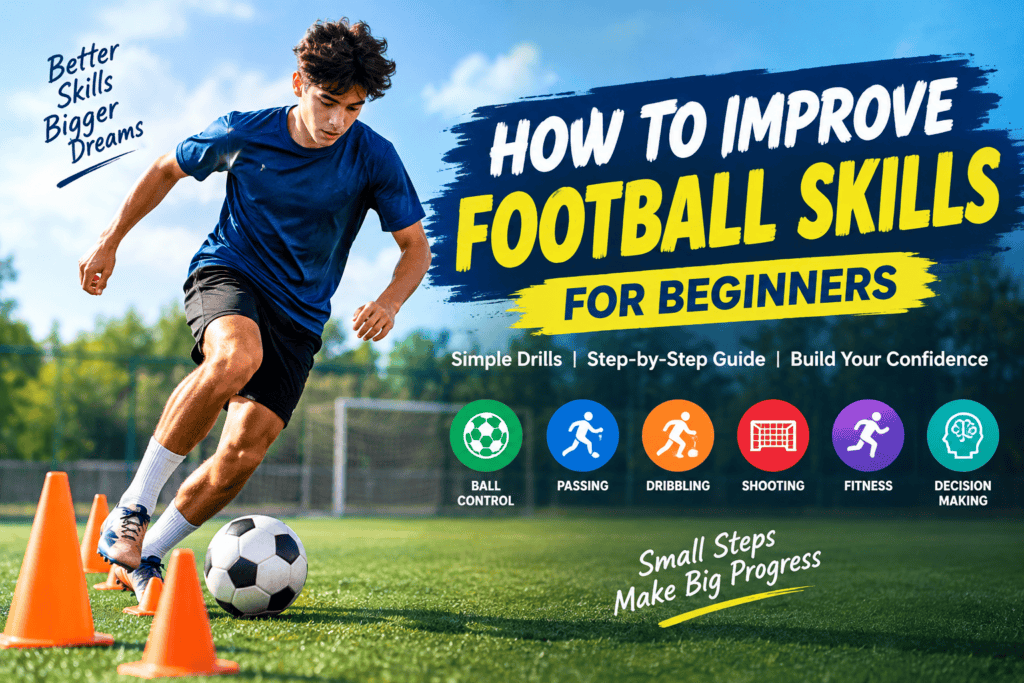
Football is one of the most popular sports in the world, but becoming a better player does not require expensive equipment or professional coaching from day one. Beginners can improve their football skills by practicing the right techniques consistently and building good habits over time.
Whether you are completely new to football or already play casually with friends, focusing on basic skills can make a big difference. Ball control, passing, dribbling, shooting, movement, fitness, and decision-making are some of the most important areas to develop.
In this complete guide, you will learn how to improve football skills for beginners, which drills to practice, how often to train, and how to create a simple football practice routine.
Why Football Skills Matter for Beginners
Football is more than simply running after the ball. Good players need to control the ball, make quick decisions, communicate with teammates, and understand where to move on the pitch.
For beginners, the best approach is to focus on the fundamentals before trying advanced tricks.
Some important beginner football skills include:
- Ball control
- Short and long passing
- Dribbling
- Shooting
- First touch
- Ball juggling
- Defensive positioning
- Speed and agility
- Movement without the ball
- Decision-making
You do not need to master everything immediately. Improving one skill at a time can help you build confidence and become a more complete player.
1. Improve Your First Touch
Your first touch is one of the most important football skills to learn.
A good first touch allows you to receive the ball and prepare it for your next action. A poor first touch can make the ball difficult to control and give an opponent an opportunity to win possession.
How to Practice Your First Touch
Find a wall or training partner and pass the ball against the wall.
When the ball comes back:
- Receive it with your foot.
- Keep the ball close to your body.
- Use the inside of your foot to control it.
- Try moving the ball into the space where you want to go next.
- Repeat with both feet.
Start slowly and focus on control rather than speed.
As your confidence improves, increase the passing speed and practice receiving the ball from different angles.
2. Practice Short Passing
Passing is a basic football skill that every player needs.
Beginners should first learn accurate short passes before trying difficult long passes.
The inside of your foot is generally useful for controlled short passing.
Simple Passing Drill
You can practice against a wall:
- Stand several feet away.
- Pass the ball toward the wall.
- Receive the return pass.
- Pass it again using the same foot.
- Switch to your other foot.
- Gradually increase the distance.
Try to keep your passes accurate and controlled.
The goal is not simply to kick the ball hard. The goal is to send the ball to the correct place.
3. Improve Your Dribbling
Dribbling means moving with the ball while maintaining control.
Beginners often make the mistake of trying complicated tricks too early. Instead, start with simple movements.
Practice moving the ball:
- Forward
- Backward
- Left
- Right
- Around cones
- Through small spaces
Beginner Cone Dribbling Drill
Place several cones or safe markers in a straight line.
Then:
- Start with the ball at your feet.
- Move around each marker.
- Keep the ball close.
- Use both feet.
- Look up occasionally instead of constantly watching the ball.
- Repeat the course several times.
Once you become comfortable, increase your speed while maintaining control.
4. Learn to Use Both Feet
One of the best ways to improve as a beginner is to become comfortable using both feet.
Many new players rely almost completely on their stronger foot. This can make passing, dribbling and shooting more difficult when the ball reaches the weaker side.
Try to spend part of every training session practicing with your weaker foot.
For example:
10 minutes: stronger foot
10 minutes: weaker foot
You may initially make more mistakes with your weaker foot, but regular practice can improve your confidence and coordination.
5. Practice Ball Juggling
Ball juggling is a simple exercise for improving touch and coordination.
Start with one foot and try to keep the ball in the air.
You can progress gradually:
- One touch
- Two touches
- Five touches
- Ten touches
- Alternating feet
- Thigh and foot combinations
Do not worry if you cannot juggle many times at first. Consistency matters more than the number of touches.
Even a few minutes of juggling practice can help you become more comfortable with the ball.
6. Improve Your Shooting Technique
Scoring goals is one of the most exciting parts of football, but good shooting requires technique.
Beginners should first focus on accuracy rather than maximum power.
When practicing shooting:
- Keep your eyes on the ball.
- Plant your non-kicking foot beside the ball.
- Strike the ball with the appropriate part of your foot.
- Keep your body balanced.
- Follow through naturally.
- Aim for specific areas of the goal.
Start with short-distance shooting and gradually move farther away.
7. Practice Shooting With Both Feet
Being able to shoot with both feet can give you more options during a match.
Start by taking controlled shots from a short distance.
For example:
5 shots with your stronger foot
5 shots with your weaker foot
As your technique improves, increase the number of repetitions.
Focus on placing the ball accurately instead of simply trying to hit it as hard as possible.
8. Improve Your Football Speed and Agility
Football requires more than endurance. Players often need to accelerate, slow down, change direction and react quickly.
Agility training can help you become more comfortable with these movements.
Simple exercises include:
- Short acceleration runs
- Side-to-side movements
- Cone changes of direction
- Controlled shuttle runs
- Footwork drills
Keep the exercises appropriate for your fitness level and allow enough recovery between harder efforts.
9. Work on Your Movement Without the Ball
A common beginner mistake is to focus only on the player who has the ball.
Football players also need to move when they do not have possession.
Good movement can:
- Create space
- Give teammates passing options
- Help your team attack
- Make it harder for defenders to mark you
During practice matches, pay attention to where you can move to support the player with the ball.
Instead of standing still, look for useful spaces.
10. Improve Your Football Passing Vision
Passing is not only about technique. You also need to know where and when to pass.
Before receiving the ball, try to look around and identify available teammates and open spaces.
This can help you make decisions faster.
A useful habit is:
Look → Receive → Control → Decide → Pass
With practice, this process can become more natural.
11. Learn Basic Defensive Skills
Even attacking players should understand basic defending.
Important defensive habits include:
- Staying between the opponent and the goal
- Watching the ball
- Maintaining appropriate distance
- Moving with the opponent
- Communicating with teammates
- Avoiding unnecessary challenges
Beginners should learn to defend with patience rather than simply chasing the ball.
12. Practice With a Wall
A wall can become one of the most useful training partners for a beginner.
You can practice:
- Passing
- First touch
- Weak-foot control
- Quick reactions
- Receiving the ball
- Short combinations
A simple 15-minute wall session can include:
5 minutes: right-foot passing
5 minutes: left-foot passing
5 minutes: alternating touches
As you improve, make the exercise faster and more challenging.
13. Create a Simple Football Training Routine
You do not need to train for hours every day.
A consistent routine can be more useful than occasional long sessions.
Example Beginner Training Session
Warm-up – 5 to 10 minutes
Use light movement and dynamic exercises to prepare your body.
Ball control – 10 minutes
Practice touches, juggling and first-touch exercises.
Passing – 10 minutes
Use a wall or training partner.
Dribbling – 10 minutes
Practice cone movements and changes of direction.
Shooting – 10 to 15 minutes
Practice controlled finishing if you have a safe place to do so.
Cool-down – 5 minutes
Finish with easy movement and recovery.
Adjust the session based on your age, fitness level, available space and experience.
14. Practice Consistently
One of the biggest secrets to improving football skills is consistency.
Practicing for a short period regularly can be more useful than doing one very long session and then stopping for several weeks.
For example, you could practice your skills 3–4 times per week, depending on your schedule and recovery needs.
Keep track of what you practice.
You might record:
- Number of passing repetitions
- Juggling attempts
- Shooting accuracy
- Dribbling time
- Weak-foot practice
Tracking progress can help you see improvements over time.
15. Watch Football and Learn From the Game
Playing is important, but watching football can also help beginners understand the game.
When watching a match, do not only watch the player with the ball.
Pay attention to:
- Player positioning
- Passing options
- Defensive movement
- Off-ball runs
- Space
- Team formations
- Decision-making
Try to understand why players move into certain areas.
This can improve your football knowledge and help you make better decisions when you play.
16. Avoid Trying Too Many Tricks
Football tricks can be fun, but beginners should not spend all their training time learning complicated skills.
Basic skills are more important.
Focus first on:
Control → Passing → Dribbling → Shooting → Movement → Decision-making
Once your fundamentals become stronger, you can gradually add more advanced techniques.
17. Build Confidence Through Small Improvements
Every beginner makes mistakes.
You may lose the ball, miss a shot, make an inaccurate pass or struggle with your weaker foot.
That is completely normal when learning.
Instead of focusing on mistakes, identify one thing you can improve during your next session.
For example:
“Today I will focus on controlling the ball with my weaker foot.”
Small goals can make training easier and more motivating.
18. Practice in Different Situations
Once you become comfortable with basic drills, make your practice more realistic.
Instead of always standing still when passing, try:
- Receiving while moving
- Passing after dribbling
- Changing direction
- Controlling the ball under pressure
- Making quick decisions
- Playing small-sided games
These activities can help you transfer your training skills into real matches.
Common Football Training Mistakes Beginners Should Avoid
1. Practicing Only the Strong Foot
Using only your stronger foot can limit your options.
2. Focusing Only on Power
Power is useful, but accuracy and control are also important.
3. Ignoring the First Touch
A good first touch makes many other football skills easier.
4. Training Without Rest
Your body needs time to recover. Avoid constantly training through pain or excessive fatigue.
5. Trying Advanced Skills Too Soon
Build your fundamentals first.
6. Never Practicing Game Situations
Individual drills are useful, but playing actual football helps you learn decision-making and positioning.
How Long Does It Take to Improve Football Skills?
There is no exact timeline because everyone learns at a different pace.
Your progress can depend on:
- Practice frequency
- Current skill level
- Training quality
- Age and experience
- Fitness
- Coaching
- Motivation
- Recovery
With consistent practice, beginners can gradually become more comfortable with the ball and improve their basic technique.
The key is to focus on steady progress rather than expecting instant results.
A 4-Week Beginner Football Practice Plan
Week 1: Ball Control
Focus on:
- First touch
- Juggling
- Basic passing
- Using both feet
Week 2: Dribbling
Add:
- Cone dribbling
- Direction changes
- Close ball control
- Weak-foot practice
Week 3: Shooting and Movement
Practice:
- Controlled shooting
- Passing combinations
- Movement without the ball
- Basic attacking decisions
Week 4: Combine Your Skills
Create sessions that include:
- Ball control
- Passing
- Dribbling
- Shooting
- Movement
- Small-sided games
The goal is to combine individual skills rather than practicing them separately all the time.
Frequently Asked Questions
How can beginners improve football skills quickly?
The best approach is consistent practice of basic skills such as ball control, passing, dribbling, shooting and movement. Focus on technique first and gradually increase difficulty.
What football skill should beginners learn first?
Ball control and first touch are excellent starting points because they make passing, dribbling and shooting easier.
Can I improve football skills at home?
Yes. You can practice ball touches, juggling, dribbling and passing against a suitable wall if you have a safe space.
How often should beginners practice football?
A consistent routine of several practice sessions each week can be effective. Training should be balanced with rest and recovery.
How can I improve my weaker foot?
Use your weaker foot during passing, ball control, dribbling and shooting drills. Start slowly and prioritize accuracy.
Is football fitness important for beginners?
Yes. Football involves repeated movement, changes of direction and periods of higher effort, so developing appropriate fitness can support your overall performance.
Final Thoughts
Learning how to improve football skills for beginners does not require complicated equipment or advanced training methods. The most important thing is to build strong fundamentals and practice them consistently.
Start with ball control, first touch, passing, dribbling and shooting. Then add movement, decision-making, defensive skills and more realistic game situations.
Remember that improvement takes time. Do not compare your progress with other players. Set small goals, practice regularly, learn from mistakes and enjoy the process.
With patience and consistent practice, beginners can develop better football technique, confidence and understanding of the game.
The key formula is simple: Practice consistently + master the basics + play regularly + keep learning.