
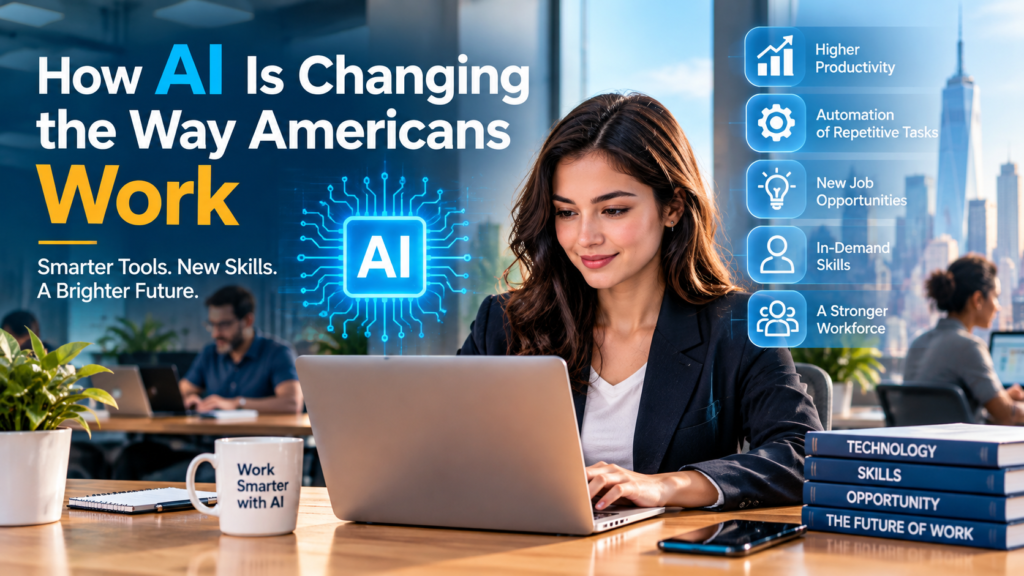
Artificial intelligence is quickly becoming a part of everyday work in the United States. From writing emails and analyzing information to creating content and automating repetitive tasks, AI is changing how many Americans approach their jobs.
The change is not limited to technology companies. Businesses across industries are exploring AI tools to improve productivity, reduce repetitive work, and help employees make faster decisions.
AI Is Becoming Part of Everyday Work
AI is no longer simply a futuristic technology. It is increasingly being used as a practical workplace tool.
According to Pew Research Center, 38% of employed U.S. adults said they use AI chatbots for tasks at work in a February 2026 survey. At the same time, many American workers still use AI little or not at all, showing that workplace adoption remains uneven.
Workers may use AI to:
- Draft and improve emails
- Summarize long documents
- Research information
- Create presentations
- Analyze data
- Generate ideas
- Write or edit content
- Automate repetitive tasks
- Assist with customer service
As these tools become easier to use, AI is becoming another digital tool employees can use alongside traditional workplace software.
AI Can Help Workers Save Time
One of the biggest advantages of AI is its ability to handle repetitive tasks.
For example, an employee might spend a significant amount of time organizing information, preparing a first draft, or summarizing reports. AI can often help complete these initial steps much faster.
This does not necessarily mean the employee becomes unnecessary. Instead, the worker can spend more time reviewing information, making decisions, solving problems, and communicating with customers or colleagues.
The result could be a shift from doing every task manually to managing and reviewing AI-assisted work.
AI Is Changing Different Industries
AI is affecting more than office jobs. Its potential impact extends across many parts of the American economy.
In technology and data-related fields, AI is increasing demand for workers with skills in software, data science, cybersecurity, and related areas.
The U.S. Bureau of Labor Statistics projects that employment for data scientists will grow 33.5% between 2024 and 2034, while information security analyst employment is projected to grow 28.5%.
AI is also being explored in areas such as:
- Healthcare
- Finance
- Marketing
- Retail
- Manufacturing
- Education
- Customer service
- Transportation
- Professional services
The exact impact will vary depending on the occupation and the tasks involved.
AI Is Not Only About Replacing Jobs
One of the biggest questions surrounding AI is whether it will replace human workers.
The answer is more complicated than simply saying yes or no.
Some tasks can potentially be automated, while other tasks require human judgment, creativity, communication, responsibility, or physical work.
The Bureau of Labor Statistics notes that AI could affect employment in different ways. Some occupations may experience declines, while others could see increased demand. BLS specifically identifies computer and mathematical occupations among the areas where AI-related changes are expected to be significant.
This means the future of work may involve jobs changing rather than disappearing completely.
Americans Are Still Concerned About AI and Jobs
Despite the potential benefits, many Americans remain worried about the effect AI could have on employment.
A Pew Research Center survey conducted in June 2026 found that 71% of U.S. adults believe AI will lead to fewer jobs in the United States over the next 20 years. That figure was 64% in 2024.
The concern is particularly important because workers are experiencing AI adoption at different speeds.
Some employees are already using AI every day, while others have little or no experience with it. This creates a growing need for workers to understand how AI works and how to use it responsibly.
AI Skills Could Become More Important
As AI becomes more common in the workplace, employees may need to develop new skills.
Knowing how to use an AI tool effectively can become just as important as knowing how to use other workplace software.
Useful skills may include:
- Writing effective AI prompts
- Checking AI-generated information
- Understanding AI limitations
- Protecting confidential information
- Editing AI-generated content
- Combining AI with human creativity
- Using data responsibly
The ability to work with AI rather than simply compete against it could become an important advantage for many employees.
Human Skills Still Matter
AI can process information quickly, but human skills remain extremely important.
Communication, leadership, creativity, critical thinking, empathy, teamwork, and decision-making are difficult to reduce to simple automated tasks.
Companies may increasingly look for employees who can combine technical AI skills with strong human abilities.
For example, an AI system might generate a marketing campaign, but a human professional still needs to determine whether the message is appropriate for the audience and consistent with the company’s goals.
The Future of Work in America
The American workplace is likely to continue changing as AI technology develops.
Some jobs will become more automated. Some workers will use AI as an everyday assistant. New roles may also emerge around AI development, cybersecurity, data management, governance, and implementation.
The U.S. Bureau of Labor Statistics projects that total U.S. employment will grow by about 5.9 million jobs between 2025 and 2035, while also incorporating new AI exposure categories into its employment projections.
This suggests that the future will not simply be about humans versus machines. Instead, many workplaces could become environments where people and AI systems work together.
Final Thoughts
AI is changing the way Americans work by helping employees complete tasks faster, analyze information, create content, and automate repetitive activities.
At the same time, concerns about job displacement remain real. Recent surveys show that many Americans expect AI to reduce the number of available jobs over the long term.
The most important change may therefore be the growing need to adapt.
Workers who learn how to use AI effectively, verify its output, protect sensitive information, and combine technology with strong human skills may be better prepared for the evolving workplace.
AI is not simply changing the tools Americans use at work. It is changing how work itself is organized—and that transformation is likely to continue for years to come.