
Introduction
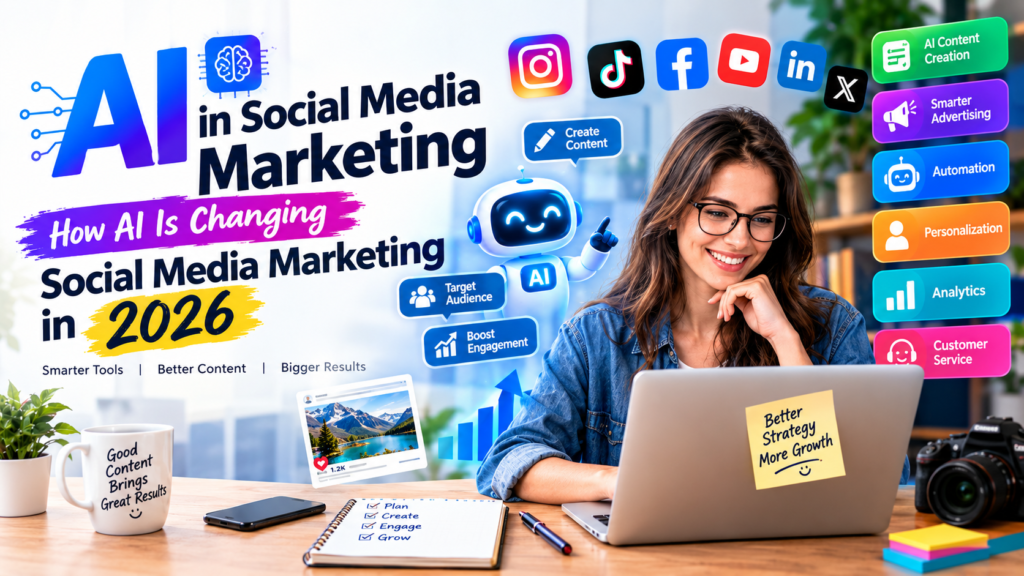
Artificial intelligence (AI) is changing the way businesses create content, advertise products, understand customers, and manage social media campaigns. In 2026, AI is no longer just a futuristic technology. It has become a practical part of everyday social media marketing.
From generating captions and video ideas to analyzing campaign performance and personalizing customer experiences, AI can help marketers work faster and make more informed decisions.
Platforms such as Facebook, Instagram, and TikTok are also investing heavily in AI-powered advertising, content recommendations, creative tools, and business automation. Meta, for example, says its AI systems are increasingly being used to improve ad creative, campaign optimization, recommendations, and business messaging.
For businesses in the United States and around the world, understanding how AI is changing social media marketing can provide a competitive advantage.
1. AI Is Making Content Creation Faster
One of the biggest changes AI has brought to social media marketing is faster content creation.
Traditionally, creating a social media campaign could require a copywriter, designer, video editor, photographer, and marketing specialist. AI tools can now assist with many of these tasks.
Marketers can use AI to generate:
- Social media captions
- Blog and post ideas
- Video scripts
- Product descriptions
- Headlines
- Ad copy
- Content calendars
- Image concepts
- Short-form video ideas
Instead of starting from a blank page, marketers can use AI to create a first draft and then improve it with their own brand voice.
However, AI-generated content should not simply be published without review. Human creativity, editing, fact-checking, and brand personality remain important.
2. AI Is Transforming Short-Form Video
Short-form video remains one of the most important formats for social media marketing.
Platforms such as TikTok, Instagram Reels, YouTube Shorts, and Facebook Reels have created enormous opportunities for businesses to reach new audiences.
AI is making video production easier by helping marketers generate scripts, ideas, visual concepts, captions, and even video assets.
TikTok is expanding its AI-powered Symphony tools to help advertisers create and optimize creative content. Its 2026 announcements include AI video generation, creator-content discovery, and automated creative selection.
This means a small business may be able to produce more creative variations without needing a large production team.
3. AI Is Improving Social Media Advertising
Paid social advertising is another area being significantly affected by AI.
Advertising platforms can analyze huge amounts of data and use machine learning to help determine which audiences, creatives, placements, and messages are likely to perform well.
Meta says its AI-powered advertising systems are being used to improve ad ranking and creative performance. In its 2026 update, Meta reported improvements in ad clicks and conversions associated with its newer AI systems.
For marketers, this means campaigns are becoming less dependent on manually adjusting every individual setting.
Instead, marketers increasingly provide:
- Campaign objectives
- Creative assets
- Budget
- Audience information
- Conversion goals
AI-powered systems can then help optimize delivery.
4. AI Is Personalizing Customer Experiences
Customers do not all want the same content.
Someone interested in fitness may respond to workout content, while another person may be more interested in sports equipment or nutrition.
AI can help businesses understand these differences and deliver more relevant experiences.
Meta is expanding AI-based personalization across its services, including the use of business activity to personalize feeds and AI experiences.
For marketers, personalization can mean showing different content or offers based on customer interests, behavior, previous interactions, or purchasing activity.
The goal is simple: show the right message to the right person at the right time.
5. AI Is Changing Customer Service on Social Media
Social media is no longer only a place for publishing posts.
Customers often use Facebook Messenger, Instagram, WhatsApp, and other platforms to ask businesses questions about:
- Prices
- Product availability
- Delivery
- Returns
- Business hours
- Product features
- Order information
AI-powered business assistants can help answer common questions quickly.
Meta introduced Meta Business Agent in 2026, describing it as an AI tool that can help businesses provide personalized customer experiences. Meta said more than one million businesses were already using a Meta Business Agent on WhatsApp and Messenger at the time of its announcement.
For small businesses, this could reduce the amount of time spent answering repetitive questions.
6. AI Is Helping Marketers Understand Data
Social media generates a huge amount of information.
Businesses can track:
- Likes
- Comments
- Shares
- Video views
- Click-through rates
- Conversion rates
- Customer interactions
- Ad performance
- Audience behavior
The challenge is turning all this information into useful decisions.
AI can help marketers identify patterns in their data and highlight areas that deserve attention.
Instead of manually reviewing hundreds of numbers, marketers can use AI-assisted analytics to ask questions such as:
Which advertisement generated the most conversions?
Which audience performed best?
Which type of video received the highest engagement?
What content should we test next?
Google is also emphasizing AI-powered marketing and measurement tools in its 2026 marketing products, with a focus on connecting data and making marketing decisions faster.
7. AI Is Helping Businesses Test More Content
One advantage of AI is the ability to create multiple variations quickly.
For example, a business selling skincare products could create several versions of the same campaign:
Version A: Focus on convenience
Version B: Focus on product benefits
Version C: Focus on customer problems
Version D: Focus on price
Version E: Focus on lifestyle
The business can then test different creatives and messages to determine what resonates with its audience.
TikTok’s 2026 advertising updates include AI-powered creative selection designed to help advertisers identify which creative assets may perform best.
This approach allows marketers to experiment more instead of relying on a single advertisement.
8. AI Is Making Social Media Automation More Powerful
Social media management can consume hours every week.
Businesses have to plan posts, write captions, respond to customers, review analytics, and manage campaigns.
AI-powered automation can assist with repetitive tasks.
For example, a marketer might use AI to:
- Generate a weekly content calendar
- Suggest posting ideas
- Create caption variations
- Summarize analytics
- Identify popular topics
- Draft customer responses
- Generate advertising concepts
Automation does not mean marketers should completely remove humans from the process.
Instead, the best strategy is to let AI handle repetitive work while people focus on creativity, strategy, relationships, and decision-making.
9. AI Is Changing Influencer and Creator Marketing
Influencer marketing is also becoming more data-driven.
Businesses want to know which creators are most relevant to their target audience and which creators can generate meaningful engagement.
AI can help marketers discover creators, analyze content, identify trends, and organize campaigns.
TikTok’s 2026 Symphony Agent announcements include AI-assisted creator discovery and campaign execution, helping brands identify creators and develop creator briefs at scale.
This could make creator marketing more accessible to small businesses that previously struggled to manage large numbers of influencer relationships.
10. AI Is Changing Social Media Search
Social media platforms are increasingly becoming search and discovery platforms.
People use TikTok, Instagram, YouTube, and other platforms to discover:
- Products
- Restaurants
- Travel destinations
- Tutorials
- Reviews
- Businesses
- Trends
- Entertainment
AI is making these discovery systems more sophisticated.
TikTok’s 2026 product announcements highlighted AI-powered discovery and new search-related experiences designed to connect people with brands and products.
This means businesses should think beyond traditional hashtags.
They should also create content around the questions and topics their customers are actually searching for.
11. AI Will Not Replace Human Creativity
Although AI is becoming more powerful, human creativity remains essential.
AI can generate content quickly, but it does not automatically understand a company’s personality, customers, culture, or long-term goals.
The strongest social media strategies in 2026 are likely to combine AI efficiency with human creativity.
A marketer can use AI for research and ideas, but humans should decide:
- What the brand stands for
- What stories to tell
- Which customers to target
- What tone to use
- What claims are appropriate
- Which content represents the brand
AI should be treated as a marketing assistant rather than a complete replacement for marketers.
12. Privacy and Accuracy Still Matter
Businesses should also be careful when using AI.
AI-generated content can sometimes contain incorrect information, misleading claims, or inappropriate language. Businesses should review important content before publishing it.
Privacy is another consideration.
Marketers should understand what information they are giving to AI tools and follow applicable privacy and data-protection requirements.
AI can make marketing faster, but speed should never come at the expense of customer trust.
How Small Businesses Can Start Using AI
Businesses do not need dozens of AI tools to get started.
A simple approach is better.
Step 1: Find a repetitive task
Choose something that takes significant time every week, such as writing captions or analyzing campaign results.
Step 2: Choose one AI tool
Start with one tool that solves that specific problem.
Step 3: Create a repeatable workflow
For example:
Idea → AI draft → Human editing → Publish → Analyze results
Step 4: Measure the results
Compare your time, content output, engagement, leads, or sales before and after introducing AI.
Step 5: Expand gradually
Once one workflow works well, introduce AI into another area of your marketing.
The Future of AI and Social Media Marketing
The relationship between AI and social media marketing will likely become even stronger.
AI is moving beyond simple content generation toward systems that can assist with planning, optimization, customer service, creative development, and business operations.
Meta is developing AI systems that can work across its apps and assist with tasks, while TikTok is expanding AI-powered creative and advertising solutions.
For marketers, this means the competitive advantage may not come from simply using AI.
It may come from knowing how to use AI better than competitors.
Businesses that combine strong creative ideas, useful content, customer understanding, and responsible AI adoption will be better positioned to compete in the changing social media environment.
Conclusion
AI is changing social media marketing in 2026 by making content creation faster, advertising more automated, customer service more responsive, and marketing analytics easier to use.
From AI-generated videos and captions to personalized customer experiences and automated advertising, businesses now have more tools than ever to improve their social media strategies.
But AI should not replace human creativity.
The most effective approach is to use AI for speed, research, automation, and optimization while keeping humans responsible for strategy, creativity, quality, and brand voice.
For small businesses in particular, starting with one time-consuming marketing task and gradually expanding AI usage can be a practical way to gain efficiency without overwhelming the team.
The future of social media marketing is not simply AI versus humans. It is AI working with humans to create smarter, faster, and more meaningful marketing.