
Social media is changing, and one of the biggest trends in the United States right now is surprisingly simple: people are watching other people live their everyday lives.
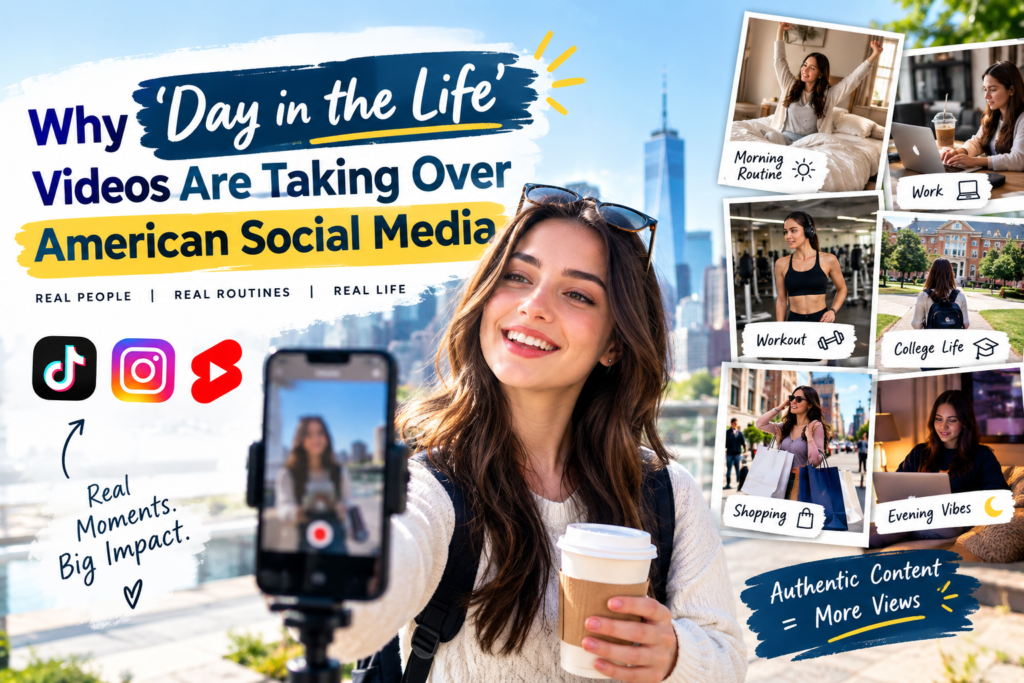
From morning coffee and office commutes to workouts, college classes, shopping trips, and evening routines, “Day in the Life” videos have become a popular format across TikTok, Instagram Reels, and YouTube Shorts.
Unlike highly polished advertisements or carefully staged influencer posts, these videos give viewers a quick look at someone’s ordinary routine. That simplicity may be one of the biggest reasons they are attracting so much attention.
What Are “Day in the Life” Videos?
A “Day in the Life” video follows a creator through part or all of their day. The format can show anything from waking up and getting ready for work to commuting, eating lunch, completing tasks, exercising, and relaxing at night.
In the U.S., the format has expanded beyond lifestyle influencers. College students, office workers, entrepreneurs, healthcare workers, athletes, and employees from different industries are using social media to document their routines.
Recent U.S. reporting has highlighted the growth of workplace-focused “day in the life” content, sometimes called WorkTok, where employees share realistic glimpses of their professional lives.
Why Americans Are Watching Everyday Routines
One reason these videos work is that they feel relatable.
Social media has traditionally been filled with highly edited photographs, luxury lifestyles, perfect homes, and carefully produced advertisements. Day-in-the-life videos offer something different: ordinary moments.
A person might watch a video of someone commuting to work in New York, studying at a college in Florida, working remotely from California, or preparing dinner after a long shift.
The activities may not seem extraordinary, but viewers can recognize themselves in them.
That sense of familiarity can make the content feel more personal and easier to connect with.
Authenticity Is Becoming More Important
The popularity of day-in-the-life videos is part of a larger shift toward authentic social media content.
Adobe’s 2026 social media trends research notes that short-form video is moving toward more spontaneous and authentic storytelling rather than highly polished production. It specifically identifies day-in-the-life and behind-the-scenes formats as useful examples.
Hootsuite’s 2026 research similarly emphasizes that AI tools are becoming common in social-media workflows, while human authenticity is increasingly important for creating meaningful connections.
This does not mean professional production is disappearing. Instead, audiences may increasingly care about whether a video feels genuine.
The Rise of “WorkTok” in America
One of the most interesting versions of the trend is WorkTok.
WorkTok videos show people going through their professional routines. A typical video might include:
- Getting ready for work
- Traveling to the office
- Starting the workday
- Meetings and computer work
- Lunch breaks
- Coffee runs
- Leaving the office
- Going to the gym
- Relaxing after work
For viewers, these videos can be entertaining, but they can also provide a window into careers and workplaces they may not personally experience.
For example, a college student might watch videos from a software engineer to understand what a typical workday looks like. Someone considering a career in finance might follow finance professionals. Another person may simply enjoy watching how other people organize their days.
College Students Are Joining the Trend
The trend isn’t limited to working professionals.
College creators across the U.S. are also documenting their daily lives, including classes, workouts, study sessions, campus activities, food runs, and social events.
A 2026 report from the University of Florida’s student newspaper highlighted creators sharing their everyday college routines through day-in-the-life content.
This type of content can make viewers feel like they are experiencing someone else’s college life through their phone.
It also gives creators an easy way to build a personal brand around their lifestyle and interests.
Why Short-Form Video Makes the Trend Stronger
The format fits perfectly with today’s short-form video platforms.
A creator doesn’t need to record an hour-long vlog. Instead, they can capture several short clips throughout the day and combine them into a 30-second or one-minute story.
Short-form video remains a major part of social media in 2026. Metricool’s analysis of more than 6 million videos found major differences between TikTok, Instagram, and YouTube Shorts, with TikTok particularly strong for video reach.
This makes the day-in-the-life format easy to consume and easy to share.
Brands Are Paying Attention
The trend is also creating opportunities for businesses.
Instead of simply showing a product against a plain background, brands can integrate products naturally into someone’s daily routine.
For example:
- A skincare creator can show a morning skincare routine.
- A fashion creator can show what they wear to work.
- A fitness creator can document a full workout day.
- A food creator can show meals throughout the day.
- A tech creator can show how they use a laptop or smartphone during work.
- A travel creator can document an entire day in a destination.
This approach can make advertising feel more like storytelling and less like a traditional advertisement.
Recent reporting also shows brands increasingly working with smaller creators because of their perceived authenticity and closer connection with niche audiences.
Micro-Creators Have an Opportunity
You don’t need millions of followers to benefit from this trend.
Micro- and nano-creators can build audiences around specific lifestyles, careers, locations, hobbies, and interests.
For example, a creator could focus on:
“Day in the Life of a Nurse in Texas”
“Day in the Life of a College Student in Florida”
“Day in the Life of a Small Business Owner in California”
“Day in the Life of a Software Developer in New York”
Specific content can help creators attract people who are genuinely interested in their niche.
The Psychology Behind the Trend
There is something naturally interesting about seeing how other people live.
People are curious about routines, habits, workplaces, homes, careers, food, and lifestyles. Day-in-the-life videos turn that curiosity into short-form entertainment.
They also create a feeling of connection.
When viewers repeatedly see the same creator making coffee, going to work, studying, exercising, or preparing dinner, that creator can begin to feel familiar—even though the relationship exists entirely through a screen.
That familiarity can encourage viewers to return for the next video.
But There Is a Downside
The trend isn’t completely positive.
Highly edited day-in-the-life videos can sometimes make ordinary life look unrealistically perfect.
A creator might show a 5 a.m. wake-up, an intense workout, a productive workday, healthy meals, social activities, and a perfectly organized home—all within one minute.
That can create unrealistic expectations about productivity and lifestyle.
Some viewers may compare their own lives with these carefully selected moments and feel that they are not doing enough.
Privacy is another concern, especially when creators film inside workplaces or reveal information about their locations and routines.
For this reason, creators should think carefully about what they share online.
What This Means for the Future of Social Media
The rise of day-in-the-life videos shows that social media does not always need something extraordinary to attract attention.
Sometimes, ordinary life is the content.
As audiences become more familiar with AI-generated and highly polished content, genuine human experiences may become even more valuable.
The strongest creators may not necessarily be the people with the most glamorous lives. They may be the people who can tell an interesting story about a normal day.
Conclusion
“Day in the Life” videos are becoming an important part of American social media because they combine authenticity, storytelling, curiosity, and short-form video.
From American college campuses to corporate offices, creators are showing audiences what everyday life actually looks like.
For creators, the trend offers a simple content format that doesn’t require an extraordinary lifestyle. For brands, it provides an opportunity to connect products with real-life experiences.
And for viewers, it offers something simple but powerful: a small window into someone else’s world.
As social media continues to evolve through 2026 and beyond, one thing is becoming clear—real life can be surprisingly entertaining.