
Artificial intelligence is quickly becoming an important part of modern business. In 2026, small businesses across the United States are using AI to save time, improve customer service, create marketing content, automate repetitive tasks, and make better business decisions.
For a small business owner, AI can be especially useful because it can help a small team accomplish tasks that previously required additional employees, expensive software, or many hours of manual work.
However, there are thousands of AI tools available today. Choosing the right ones can be difficult.
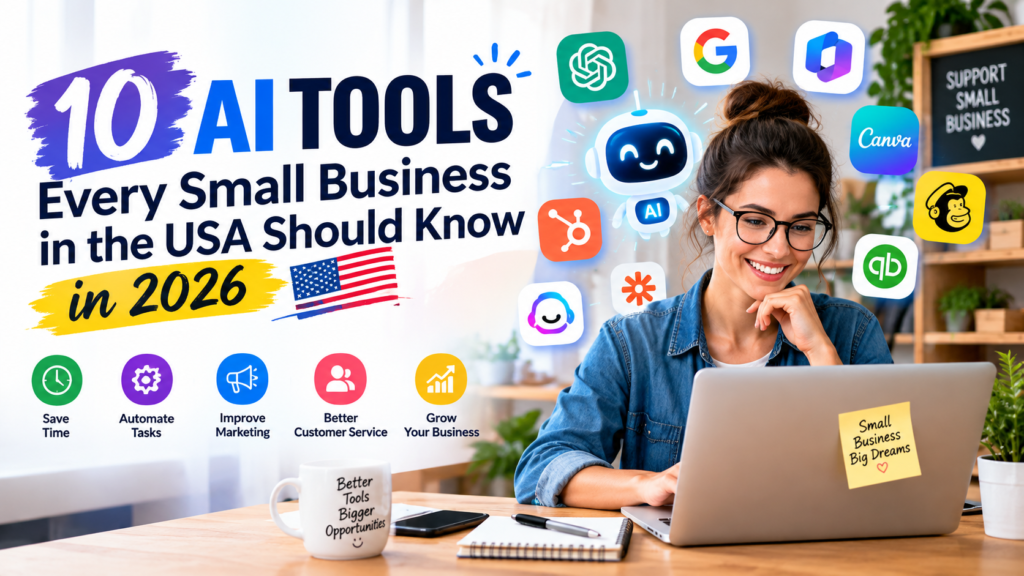
Here are 10 AI tools every small business in the USA should know about in 2026.
1. ChatGPT
ChatGPT is one of the most flexible AI tools available to small businesses.
Business owners can use it for brainstorming, writing, research, marketing, customer communication, and many other everyday tasks.
For example, a small business can use ChatGPT to create social media ideas, write product descriptions, prepare email drafts, develop blog outlines, or brainstorm advertising campaigns.
It can also help business owners organize their thoughts and turn simple ideas into structured plans.
Why small businesses can use it
- Create marketing content
- Write emails
- Generate business ideas
- Research topics
- Create social media posts
- Develop content outlines
- Improve existing writing
For businesses looking for a general-purpose AI assistant, ChatGPT can be a useful starting point.
2. Google Gemini
Google Gemini can be particularly useful for businesses already using Google’s ecosystem.
Small businesses often rely on Gmail, Google Docs, Google Sheets, Google Meet, and other Google Workspace applications. AI can help make some of these everyday tasks faster.
Business owners can use Gemini for writing assistance, brainstorming, summarizing information, and working with documents.
For example, instead of spending several minutes creating an email from scratch, a business owner can use AI to develop a first draft and then customize it.
Best for
Businesses that already use Google Workspace and want AI assistance within their existing workflow.
3. Microsoft Copilot
Microsoft Copilot is another important AI option for small businesses, especially those that use Microsoft 365.
Many American businesses rely on applications such as Word, Excel, Outlook, and Teams.
AI assistance can help employees work with documents, emails, spreadsheets, meetings, and other business tasks.
Instead of changing an entire technology system, companies already using Microsoft products can explore AI features within the Microsoft ecosystem.
Best for
- Microsoft 365 users
- Business documents
- Email productivity
- Meetings
- Workplace tasks
- Data and information
4. Canva AI
Good visual content is essential for modern marketing.
Small businesses need social media graphics, advertisements, presentations, promotional images, flyers, and other designs. Hiring a professional designer for every project can be expensive.
Canva’s AI-powered features can help business owners create and edit visual content more efficiently.
A business owner with limited design experience can create professional-looking marketing materials without needing advanced graphic-design skills.
Businesses can use Canva for:
- Instagram posts
- Facebook graphics
- Advertisements
- Presentations
- Posters
- Promotional content
- Website visuals
For small businesses that depend heavily on social media marketing, Canva can be especially useful.
5. HubSpot AI
Customer relationships are at the center of almost every successful business.
HubSpot provides tools for marketing, sales, customer relationship management, and customer service. Its AI features can help businesses reduce repetitive work and improve their marketing and sales processes.
For example, businesses can use AI-assisted features to help create content, manage customer information, and support marketing activities.
As a small company grows, having an organized customer-management system can become increasingly important.
Best for
Small businesses that want to combine marketing, sales, customer management, and AI-assisted workflows.
6. Zapier
One of the biggest advantages of AI and automation is the ability to reduce repetitive work.
Zapier allows businesses to connect different applications and automate workflows.
Imagine a potential customer submits a contact form.
Instead of an employee manually copying the information into different systems, an automated workflow can potentially send the information to the appropriate applications, notify a team member, and create a follow-up task.
This can save time every day.
Common automation examples
New lead → notification → CRM → follow-up task
New order → spreadsheet → notification → customer email
New form submission → database → sales task
For small businesses with repetitive administrative tasks, automation can provide significant value.
7. Mailchimp
Email remains an important marketing channel for small businesses.
Mailchimp provides tools for email campaigns, customer communication, and marketing automation, along with AI-assisted capabilities.
A small business can use email marketing to announce new products, share promotions, send newsletters, and maintain relationships with existing customers.
AI can help businesses generate ideas and initial content, while the business owner can edit the final message to match the company’s voice.
Best for
- Email marketing
- Newsletters
- Customer communication
- Promotions
- Marketing automation
8. QuickBooks
Managing business finances can be time-consuming.
QuickBooks is widely used for accounting and financial management, and modern accounting software increasingly incorporates automation and AI-assisted features.
Small businesses can use accounting software to organize expenses, invoices, income, and other financial information.
AI and automation can reduce some repetitive administrative tasks, allowing business owners to spend more time on running their businesses.
However, important financial and tax decisions should always be reviewed carefully, and businesses should seek professional advice when necessary.
Best for
Small businesses that want to simplify financial organization and reduce repetitive bookkeeping work.
9. Jasper
Content marketing can be difficult for small businesses that do not have a large marketing department.
Jasper is designed specifically around marketing and content creation. It can help businesses develop marketing copy, campaign ideas, website content, and other promotional materials.
AI-generated content should not simply be published without review.
The strongest results usually come when businesses use AI for the first draft and then add their own expertise, examples, brand voice, and customer knowledge.
Best for
- Marketing teams
- Advertising copy
- Website content
- Campaign ideas
- Brand messaging
10. Tidio
Customer service is another area where AI can help small businesses.
Customers frequently ask the same basic questions about products, orders, returns, business hours, and services.
AI-powered customer-support tools can help businesses respond to common questions quickly.
For example, an online store may receive questions about shipping or returns. An AI assistant can potentially answer simple questions while complicated issues are passed to a human employee.
This can help small teams provide faster customer support without requiring someone to answer every basic question manually.
Best for
Businesses that receive a large number of repetitive customer questions.
How AI Can Help Small Businesses
AI isn’t only about generating text. Its biggest value comes from helping businesses improve everyday operations.
Save Time
AI can speed up writing, research, customer communication, and administrative tasks.
Reduce Repetitive Work
Automation can handle routine processes that employees would otherwise have to perform manually.
Improve Marketing
AI can help generate content ideas, advertisements, social media posts, email campaigns, and visual concepts.
Support Customers
AI-powered customer-service tools can answer common questions and provide assistance outside normal business hours.
Increase Productivity
When employees spend less time on repetitive tasks, they can focus more on customers, sales, strategy, and business growth.
How to Choose the Right AI Tool
Small businesses don’t need to use every AI tool available.
The best approach is to identify the biggest problem in your business first.
If your biggest challenge is content creation, start with a tool such as ChatGPT or Jasper.
If you need better visual marketing, Canva may be a better choice.
If your company relies on Google Workspace, Gemini could fit naturally into your workflow.
If your team uses Microsoft 365, Copilot may be worth exploring.
If repetitive tasks are taking too much time, automation through Zapier could be more valuable than another writing tool.
The goal should always be to solve a real business problem rather than adopting AI simply because it is popular.
Things Small Businesses Should Know Before Using AI
AI can provide significant benefits, but it should be used responsibly.
First, always review AI-generated information. AI systems can make mistakes, so important business information should be checked before it reaches customers.
Second, protect confidential information. Businesses should understand the privacy and security policies of an AI service before entering sensitive customer or company information.
Third, maintain a human voice. Content created entirely by AI can sometimes sound generic. Adding real experience, opinions, examples, and brand personality can make business content more useful and authentic.
Finally, keep track of costs. Buying subscriptions to numerous AI tools can quickly become expensive. Start with the tools that provide the greatest value.
Final Thoughts
AI is becoming an important technology for small businesses in the United States in 2026.
Tools such as ChatGPT, Google Gemini, Microsoft Copilot, Canva, HubSpot, Zapier, Mailchimp, QuickBooks, Jasper, and Tidio can help businesses with everything from content creation and marketing to customer service, accounting, productivity, and automation.
The key is not to use as many AI tools as possible.
Instead, choose the tools that solve your biggest problems.
Start with one task, test an AI solution, measure the results, and improve the workflow over time.
For small businesses, the real opportunity is using AI to save time, reduce repetitive work, improve customer experiences, and create more opportunities for growth.