
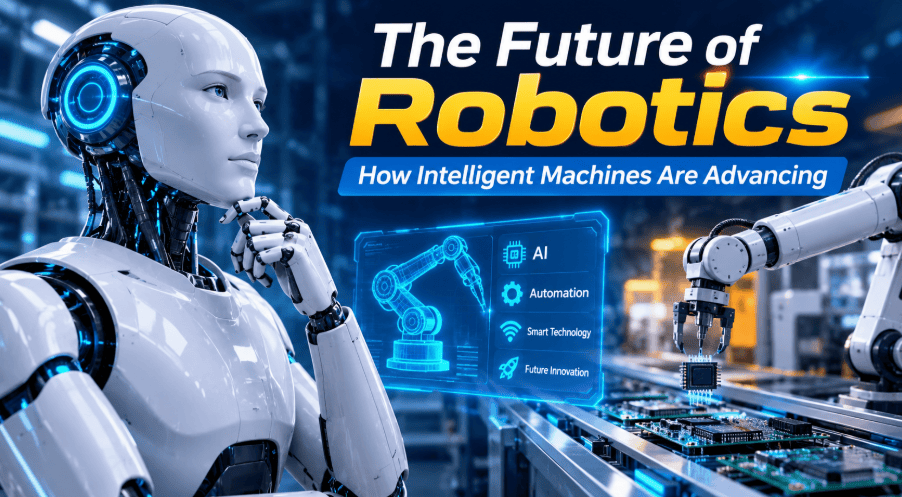
Robotics is moving from science fiction into everyday life. Robots are no longer limited to factory floors or highly controlled research environments. Today, intelligent machines are being developed for healthcare, logistics, agriculture, manufacturing, transportation, education, and even household tasks.
The combination of artificial intelligence, computer vision, sensors, advanced processors, and machine learning is making modern robots more capable than previous generations. Instead of simply following a fixed set of instructions, many new robotic systems can analyze their surroundings, recognize objects, learn from data, and make decisions based on changing conditions.
As these technologies continue to develop, the future of robotics could significantly change how people work and interact with machines.
What Is Intelligent Robotics?
Traditional robots generally perform repetitive tasks according to predefined instructions. For example, an industrial robot might repeatedly move an object from one location to another.
Intelligent robotics goes further by combining robotics hardware with technologies such as artificial intelligence and machine learning. These systems can process information from cameras, microphones, sensors, and other devices to understand their environment.
This allows robots to perform more complicated tasks, including navigating unfamiliar spaces, identifying objects, avoiding obstacles, and adapting to changing situations.
The goal is not simply to create machines that move automatically. The goal is to develop robots that can perceive, understand, learn, and act more effectively.
Artificial Intelligence Is Driving Robotics Forward
Artificial intelligence is one of the biggest factors influencing the future of robotics.
Modern AI models can help robots understand visual information, recognize patterns, process language, and make decisions. Machine learning can also allow robotic systems to improve their performance by learning from large amounts of data.
For example, an AI-powered warehouse robot may identify packages, calculate the best route through a facility, and adjust its movement when another machine or person enters its path.
AI can also improve human-robot interaction. Instead of requiring users to operate robots through complicated controls, future systems could understand natural language instructions.
A person could potentially tell a household robot to organize a room or ask a workplace robot to retrieve a particular object.
Robots Are Becoming More Capable in Manufacturing
Manufacturing has been one of the most important areas for robotics for decades. However, the next generation of industrial robots is becoming more flexible and intelligent.
Modern robotic systems can perform tasks such as assembly, welding, packaging, inspection, and material handling. With improved computer vision and AI, robots can increasingly work with objects that are not perfectly positioned or identical.
Another important development is the growth of collaborative robots, often called cobots. These machines are designed to work alongside human employees rather than operating completely separately.
Cobots can handle repetitive or physically demanding tasks while human workers focus on activities that require creativity, judgment, and problem-solving.
Healthcare Robotics Could Transform Medical Services
Healthcare is another area where robotics could have a major impact.
Robotic technologies are already being used to assist surgeons, support rehabilitation, automate laboratory processes, and help transport materials in medical facilities.
In the future, intelligent robots could become even more useful. Advanced robotic systems may assist healthcare professionals with repetitive tasks, monitor patients, deliver supplies, and support elderly people with everyday activities.
Surgical robotics could also continue to develop as precision, imaging, and AI technologies improve.
However, healthcare robotics will require strict testing and regulation because mistakes in medical environments can have serious consequences.
The Growth of Humanoid Robots
One of the most noticeable robotics trends is the development of humanoid robots.
Humanoid robots are designed with human-like physical characteristics, such as arms, legs, hands, and a body structure that allows them to operate in environments built for people.
The idea is simple: instead of redesigning every workplace for robots, humanoid machines could potentially use existing doors, stairs, tools, shelves, and equipment.
Companies and research organizations are working on increasingly advanced humanoid systems. Their potential applications include manufacturing, logistics, maintenance, hospitality, and other environments where repetitive physical tasks are common.
However, humanoid robotics still faces major challenges involving cost, reliability, battery life, balance, safety, and real-world decision-making.
Robots in Warehouses and Logistics
The growth of online shopping has increased demand for faster and more efficient logistics systems.
Robots are already helping warehouses move products, sort packages, and manage inventory. Future systems could become even more autonomous.
AI-powered robots could coordinate with one another, identify the most efficient routes, and adjust operations according to demand.
Autonomous delivery robots and drones could also become more common in certain environments. These technologies could help businesses reduce delivery times and improve operational efficiency.
Agriculture Is Becoming More Automated
Robotics could also play an important role in the future of agriculture.
Farmers face challenges such as labor shortages, rising costs, unpredictable weather, and the need to produce more food efficiently. Intelligent machines could help address some of these problems.
Agricultural robots can potentially assist with planting, harvesting, crop monitoring, weed detection, and precision spraying.
Using cameras and AI, robots can identify individual plants and detect signs of stress or disease. This could allow farmers to apply water, fertilizer, or treatment more precisely.
The result could be more efficient use of resources and improved agricultural productivity.
Autonomous Vehicles and Mobile Robots
Robotics is closely connected with autonomous transportation.
Self-driving vehicles, autonomous delivery machines, drones, and robotic mobility systems all depend on technologies similar to those used in advanced robotics.
These systems use sensors, cameras, mapping technologies, and AI to understand their surroundings and make decisions.
Although fully autonomous transportation remains challenging, progress in sensors and artificial intelligence could gradually expand the number of environments where autonomous machines can operate safely.
Robots Could Become Part of Everyday Life
The future of robotics is not limited to factories and large companies.
Household robots could eventually perform a wider range of everyday tasks. Current consumer robots already handle activities such as vacuuming and lawn maintenance. Future systems could become more capable and versatile.
Instead of having separate machines for individual tasks, consumers may eventually use multifunctional robots capable of cleaning, organizing, carrying objects, monitoring homes, and assisting with basic household activities.
The biggest challenge will be making these machines affordable, safe, reliable, and easy to use.
Human-Robot Collaboration Will Become More Important
The future of robotics does not necessarily mean humans will be replaced by machines.
In many industries, the more realistic future is human-robot collaboration.
Robots are particularly useful for repetitive, dangerous, or physically demanding tasks. Humans remain strong in areas such as creativity, communication, emotional understanding, strategic thinking, and complex judgment.
By combining these strengths, businesses can potentially create more productive workplaces.
Workers may also increasingly need to learn how to operate, supervise, maintain, and collaborate with robotic systems.
Challenges Facing the Robotics Industry
Despite rapid progress, robotics still has significant challenges.
Cost is one major issue. Advanced robots require sophisticated hardware, sensors, processors, software, and maintenance.
Safety is another concern. Robots operating around people must be able to detect humans and respond appropriately.
Energy efficiency is also important, particularly for mobile and humanoid robots. Batteries need to provide enough power without making machines excessively heavy.
There are also concerns about privacy and cybersecurity. Robots equipped with cameras, microphones, and internet connections could collect large amounts of information.
Finally, society will need to consider how automation affects employment and what skills workers will need as robotics becomes more widespread.
What Does the Future of Robotics Look Like?
The future of robotics will likely be defined by greater intelligence, flexibility, and collaboration.
Instead of machines that simply repeat predetermined movements, future robots could understand more complex instructions and adapt to unpredictable environments.
Artificial intelligence will continue to be a major part of this transformation. Advances in computer vision, machine learning, language models, sensors, and hardware could help robots become more useful across different industries.
Robotics may also become more accessible as production costs decline and standardized technologies improve.
The most successful robots may not be the machines that look the most futuristic. They may be the ones that quietly solve real-world problems and make everyday work safer, faster, and more efficient.
Final Thoughts
The future of robotics is rapidly evolving. Intelligent machines are moving beyond traditional automation and becoming increasingly capable of understanding their surroundings, learning from information, and working alongside humans.
From manufacturing and healthcare to agriculture, logistics, transportation, and homes, robotics could influence many aspects of modern life.
There are still major technical, economic, ethical, and safety challenges to overcome. However, continued advances in artificial intelligence and robotics suggest that intelligent machines will become an increasingly important part of the global technology landscape.
The next generation of robotics will not simply be about machines that can move. It will be about machines that can understand, adapt, collaborate, and solve real-world problems.