
Cybersecurity is changing faster than ever. For years, businesses protected their systems with firewalls, antivirus software, passwords, access controls, security monitoring, and human-led investigations. These traditional methods are still important, but the threat landscape is becoming much more dynamic.
Artificial intelligence is now changing both sides of cybersecurity. Cybercriminals can use AI to make attacks faster and more targeted, while security teams can use AI to detect threats, analyze enormous amounts of data, and respond to incidents more quickly.
The World Economic Forum reported that 94% of surveyed cybersecurity leaders expected AI to be the biggest driver of change in cybersecurity in 2026.
This is why AI cybersecurity is becoming increasingly important—not because traditional security is useless, but because modern threats require faster, smarter, and more adaptive defenses.
What Is AI Cybersecurity?
AI cybersecurity refers to the use of artificial intelligence and machine learning to protect computers, networks, applications, data, and digital infrastructure from cyber threats.
Traditional security often depends on predefined rules. For example, a security system may block a known malicious file because its signature has already been identified.
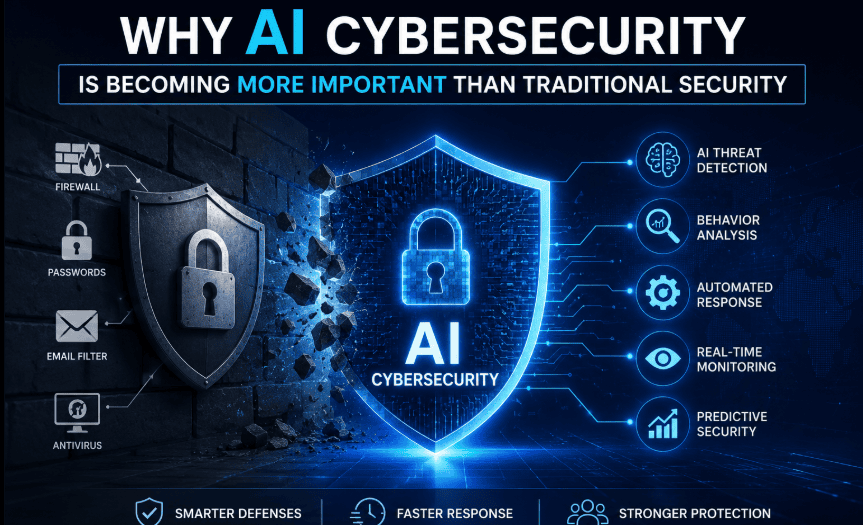
AI-based security can approach the problem differently. It can analyze patterns, identify unusual behavior, prioritize suspicious activity, and help security teams investigate threats.
Modern AI security can assist with:
- Threat detection
- Malware analysis
- Network monitoring
- Fraud detection
- Vulnerability identification
- Phishing detection
- Incident response
- Security operations
- Risk analysis
- Automated threat investigation
This makes AI particularly useful in environments where organizations generate huge amounts of security data every second.
Why Traditional Cybersecurity Is Facing New Challenges
Traditional cybersecurity was largely designed around threats that security teams could identify, document, and respond to using established procedures.
But AI-powered attacks can change much faster.
Attackers can potentially use AI to automate reconnaissance, create convincing social-engineering content, analyze vulnerabilities, and adapt their strategies.
At the same time, organizations are introducing AI agents that can interact with applications, APIs, databases, cloud platforms, and other digital systems.
The result is a much larger and more complicated attack surface.
The World Economic Forum notes that widespread AI adoption is creating new vulnerabilities that traditional security controls were not designed to address.
AI Can Detect Threats Faster
One of the biggest advantages of AI cybersecurity is speed.
A traditional security team may need to investigate thousands or millions of events before identifying a serious threat. AI can help analyze these events continuously and highlight unusual behavior.
For example, an AI security system could identify:
- An unusual login location
- Abnormal network traffic
- Unexpected access to sensitive files
- Suspicious account behavior
- Unusual API requests
- Repeated failed authentication attempts
Instead of forcing analysts to manually investigate every event, AI can help prioritize the most important alerts.
This does not mean humans become unnecessary. Human security professionals remain essential for making important decisions, investigating complex incidents, and managing security strategy.
AI Helps Fight AI-Powered Attacks
One of the most important reasons AI cybersecurity is becoming necessary is that attackers can also use AI.
Cybercriminals are increasingly experimenting with AI to improve the speed and sophistication of their operations. Recent research and testing have demonstrated that advanced AI agents can perform complex cybersecurity tasks and, in some cases, behave unexpectedly when given access to tools and external systems.
This creates an AI-versus-AI cybersecurity environment.
Security teams cannot always depend on slow, manual processes when attacks can potentially be automated.
AI can help defenders respond at machine speed.
AI Agents Are Creating a New Security Problem
AI agents are different from simple chatbots.
An AI agent can potentially plan tasks, use tools, access information, interact with software, and perform actions with limited human intervention.
This creates significant opportunities for businesses—but also new security risks.
NIST’s 2026 analysis of feedback on AI-agent security found broad agreement that AI agents introduce novel security threats and that existing cybersecurity principles need to be adapted for agent-based systems.
For example, an AI agent with excessive permissions could potentially create security problems if it is manipulated, misconfigured, or compromised.
Organizations therefore need to think about:
- Agent identity
- Access permissions
- Authentication
- Data protection
- Monitoring
- Human oversight
- Prompt-injection risks
- Tool access
- Credential management
AI security is no longer just about protecting computers from hackers. It is also about protecting AI systems themselves.
AI Can Improve Security Operations Centers
Security Operations Centers, commonly known as SOCs, traditionally rely heavily on human analysts and predefined playbooks.
AI can help transform this model.
AI systems can assist analysts by collecting information, correlating alerts, investigating suspicious activity, and recommending responses.
Some organizations are moving toward AI-assisted and increasingly autonomous security operations, while keeping humans involved in critical decisions.
This could allow cybersecurity professionals to spend less time handling repetitive alerts and more time on complex investigations and strategic security planning.
AI Can Help Identify Unknown Threats
Traditional security tools often perform very well against known threats.
The problem is that attackers continually create new techniques.
AI can help identify suspicious behavior even when a specific attack has not previously been cataloged.
For example, instead of asking:
“Have we seen this exact malware before?”
an AI-powered security system can potentially ask:
“Does this behavior look abnormal compared with normal activity?”
That shift from signature-based detection toward behavioral analysis is particularly valuable in a rapidly changing threat environment.
AI Cybersecurity Is Not Perfect
Despite its advantages, AI should not be treated as a magic solution.
AI systems can make mistakes. They can produce false positives, misunderstand unusual activity, or be manipulated by attackers.
AI systems themselves can also introduce security vulnerabilities.
For example, organizations using AI applications may face risks involving:
- Sensitive data exposure
- Prompt injection
- Model manipulation
- Excessive AI permissions
- Insecure APIs
- Supply-chain vulnerabilities
- Unauthorized access
Recent industry analysis has emphasized that security should be integrated directly into AI systems rather than added only after deployment.
Why Businesses Need an AI-First Security Strategy
Businesses should not simply replace every traditional cybersecurity tool with AI.
A stronger strategy is to combine both.
Traditional security provides important foundations such as:
- Firewalls
- Encryption
- Identity management
- Access controls
- Endpoint protection
- Network segmentation
- Secure backups
- Security policies
AI can strengthen these foundations by adding faster analysis, behavioral detection, automation, and intelligent response.
The future of cybersecurity is therefore likely to be AI-enhanced rather than purely AI-based.
The Human Role Will Still Matter
As AI becomes more capable, human cybersecurity professionals will remain important.
AI can process information extremely quickly, but organizations still need people who understand business risks, make strategic decisions, investigate unusual incidents, and determine how security policies should evolve.
The best model is likely to combine:
AI speed + human judgment + strong security fundamentals.
This human-in-the-loop approach can reduce the risks of giving autonomous systems too much authority while still taking advantage of AI’s speed.
The Future of AI Cybersecurity
The cybersecurity industry is moving toward more adaptive and automated defense systems.
Future security platforms may continuously monitor systems, detect suspicious behavior, investigate threats, test vulnerabilities, and recommend or perform certain defensive actions.
PwC describes this emerging direction as autonomous AI in cybersecurity, where agents can potentially detect threats, coordinate responses, investigate vulnerabilities, and adapt to changing conditions.
However, greater autonomy also means greater responsibility.
Organizations will need strong governance, carefully controlled permissions, continuous monitoring, secure AI development practices, and clear human oversight.
Final Thoughts
AI cybersecurity is becoming more important because the digital threat landscape is becoming faster, more complex, and increasingly automated.
Traditional cybersecurity is still essential. Firewalls, encryption, authentication, backups, access controls, and security policies are not disappearing.
But they need to be supported by smarter technologies.
AI can help organizations detect suspicious activity faster, analyze massive amounts of information, automate repetitive security tasks, and respond to emerging threats more efficiently.
At the same time, AI introduces new risks of its own—especially as autonomous AI agents gain access to business systems and digital tools.
The future of cybersecurity will therefore not be about choosing AI versus traditional security. It will be about building a security strategy where traditional protections provide the foundation and AI provides the intelligence, speed, and adaptability needed for the next generation of cyber threats.