
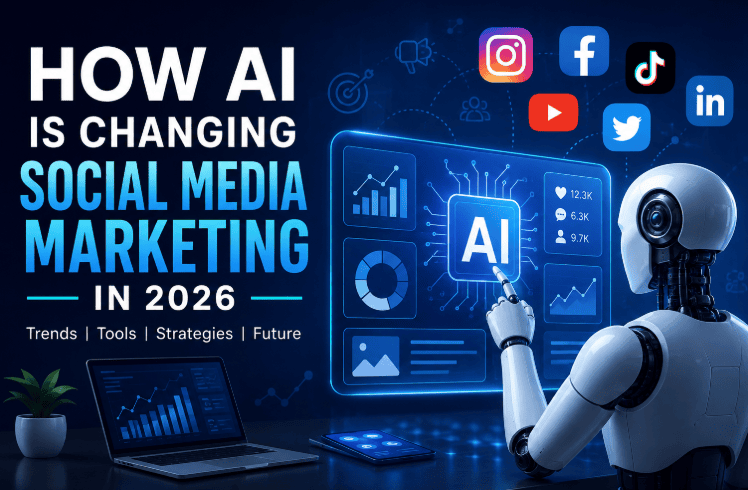
Artificial intelligence (AI) is rapidly changing the way businesses create content, connect with customers, and grow their brands on social media. In 2026, platforms such as Instagram, Facebook, TikTok, YouTube, LinkedIn, and X are becoming increasingly influenced by AI-powered tools and algorithms.
For businesses, AI is no longer simply a futuristic technology. It has become a practical part of modern social media marketing. From generating content ideas to analyzing audience behavior, AI can help marketers save time, improve campaigns, and make better decisions.
What Is AI-Powered Social Media Marketing?
AI-powered social media marketing means using artificial intelligence tools to automate, analyze, and improve different marketing activities.
Traditional social media marketing often requires marketers to manually research trends, create content, analyze performance, and respond to customers. AI can assist with many of these tasks by processing large amounts of information and identifying patterns much faster.
Businesses can use AI for content creation, audience research, social listening, advertising optimization, customer service, and performance analysis.
1. AI Is Making Content Creation Faster
One of the biggest changes AI has brought to social media marketing is faster content creation.
AI tools can help marketers generate:
- Social media captions
- Blog ideas
- Video concepts
- Content calendars
- Headlines
- Product descriptions
- Advertising copy
- Short-form video scripts
Instead of starting from a blank page, marketers can use AI to develop an initial idea and then improve it with their own creativity and brand voice.
However, businesses should not depend entirely on AI-generated content. Human creativity, experience, originality, and brand personality remain important for creating content that audiences trust.
2. AI Is Improving Audience Targeting
Understanding the target audience is essential for successful social media marketing. AI can analyze large amounts of audience data and identify patterns in user interests, behaviors, engagement, and interactions.
This can help businesses understand:
- What content their audience prefers
- When followers are most active
- Which topics generate engagement
- What types of users are interested in their products
- Which campaigns are performing well
With better audience insights, marketers can create more relevant campaigns instead of using the same message for everyone.
3. Personalized Social Media Experiences
Consumers increasingly expect brands to provide content that feels relevant to them.
AI can help businesses personalize marketing experiences by analyzing user behavior and preferences. For example, an online store may use AI-powered systems to recommend products based on previous interactions.
Personalization can also influence the type of advertisements, posts, recommendations, and messages users receive.
When used responsibly, personalization can help brands create stronger relationships with their audiences and improve customer experiences.
4. AI Is Changing Social Media Advertising
Social media advertising is another area being transformed by AI.
AI-powered advertising systems can analyze campaign performance and help marketers identify which audiences, creative formats, and messages are producing better results.
Instead of manually reviewing every campaign metric, marketers can use AI-assisted analytics to identify patterns and opportunities.
AI can also help businesses test different versions of advertisements, including headlines, images, videos, and calls to action.
This can make the advertising process more efficient and allow marketers to make decisions based on data rather than assumptions.
5. AI Can Help With Social Media Customer Service
Customers often expect quick responses when they contact businesses through social media.
AI-powered chatbots and virtual assistants can help answer common questions, provide basic information, and guide customers toward relevant resources.
For example, an online business could use an AI assistant to answer questions about:
- Product availability
- Shipping information
- Return policies
- Business hours
- Basic product details
More complex questions can still be handled by human customer service representatives.
The best approach is often to combine AI automation with human support rather than completely replacing human interaction.
6. AI Is Helping Marketers Understand Trends
Social media trends can change extremely quickly. A topic that becomes popular today may lose attention within a few days.
AI can analyze large amounts of social media information and help marketers identify emerging topics, keywords, conversations, and content patterns.
This allows businesses to react faster to relevant trends.
However, marketers should avoid following every viral trend. A trend is only valuable when it fits the brand, audience, and marketing goals.
7. AI-Powered Analytics Are Improving Marketing Decisions
Data is one of the most important parts of digital marketing.
Social media platforms provide businesses with information about impressions, reach, engagement, clicks, conversions, and audience behavior. AI can help marketers process this information and identify useful patterns.
Instead of simply looking at numbers, marketers can use AI-assisted analysis to ask questions such as:
- Which content performs best?
- Which audience interacts most with the brand?
- What type of content receives the most engagement?
- Which campaigns need improvement?
- What patterns appear in previous campaigns?
These insights can help businesses continuously improve their social media strategies.
8. Short-Form Video Is Becoming More AI-Driven
Short-form video continues to play an important role in social media marketing.
AI can assist marketers with video scripts, captions, editing suggestions, subtitles, content ideas, and other parts of the production process.
This can be especially useful for small businesses that do not have large marketing teams.
However, successful videos still require creativity. AI can help with production, but understanding what makes a video interesting, useful, entertaining, or emotionally engaging remains important.
9. AI Can Save Time for Small Businesses
Large companies often have dedicated marketing teams, designers, copywriters, analysts, and social media managers.
Small businesses may not have the same resources.
AI can help smaller businesses complete certain marketing tasks more efficiently. A small business owner can use AI to brainstorm content ideas, organize a posting schedule, analyze campaign data, and create drafts.
This can reduce the amount of time spent on repetitive tasks and allow business owners to focus more on customers and business growth.
10. Human Creativity Still Matters
Although AI is becoming more powerful, successful social media marketing is not only about automation.
People connect with authentic stories, emotions, opinions, experiences, and personalities. Brands that simply publish generic AI-generated content may struggle to build strong relationships with their audiences.
Human marketers are still needed to:
- Define brand identity
- Develop creative ideas
- Understand emotions
- Check accuracy
- Maintain originality
- Build relationships
- Make strategic decisions
AI should be viewed as a tool that supports marketers rather than a complete replacement for them.
The Importance of Responsible AI Use
As AI becomes more common, businesses also need to think about responsible use.
Marketers should review AI-generated information before publishing it because AI systems can sometimes produce inaccurate or misleading information.
Businesses should also consider privacy, transparency, copyright, and the responsible use of customer data.
Maintaining trust should remain a priority. Using AI efficiently should never come at the expense of customer confidence.
The Future of AI and Social Media Marketing
The relationship between AI and social media marketing is likely to become even stronger.
AI-powered tools will continue to improve content creation, audience analysis, personalization, advertising, automation, and customer support.
At the same time, consumers are likely to become more aware of AI-generated content. This could make authenticity and originality even more valuable.
Brands that combine AI technology with human creativity may have an advantage because they can benefit from automation while maintaining a genuine connection with their audiences.
Conclusion
AI is changing social media marketing in 2026 by making many marketing activities faster, more personalized, and more data-driven. Businesses can use AI to create content ideas, understand audiences, improve advertising, analyze performance, identify trends, and provide customer support.
However, AI should not replace human creativity and strategic thinking. The most effective approach is to use AI as a powerful assistant while keeping human judgment at the center of the marketing strategy.
For businesses looking to grow on social media in 2026, learning how to combine AI technology, quality content, data, and authentic communication can be an important step toward long-term digital marketing success.