
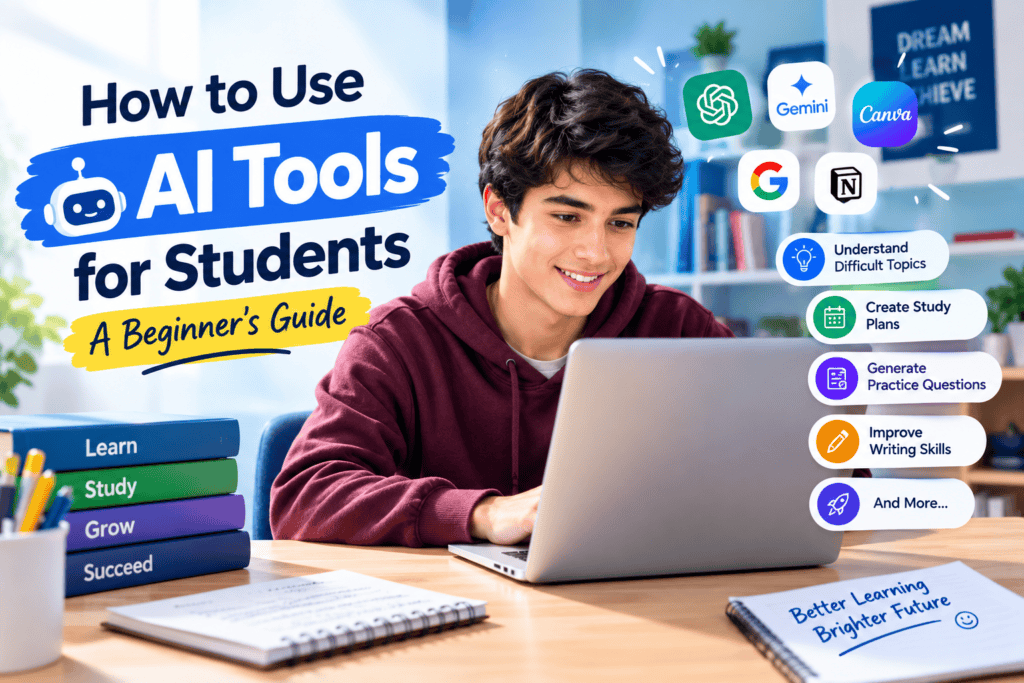
Artificial intelligence (AI) is becoming an important part of modern education. Students can use AI tools to understand difficult topics, organize their study schedules, improve writing, generate practice questions, and learn new skills. However, using AI effectively is not simply about asking a tool to do your homework.
The best approach is to use AI as a learning assistant. You can ask questions, request explanations, create study plans, and practice concepts while still doing the thinking and learning yourself.
In this beginner’s guide, you will learn how to use AI tools for students, what tasks AI can help with, how to write better prompts, and what mistakes to avoid.
What Are AI Tools for Students?
AI tools are software applications that use artificial intelligence to understand information and generate useful responses. Depending on the tool, students can use AI for writing, research, studying, brainstorming, language learning, coding, mathematics, and organization.
For example, a student who does not understand a science topic can ask an AI tool to explain the concept in simple language. A student learning a new language can use AI to practice vocabulary and conversation. A student preparing for an exam can ask AI to create practice questions from a topic they are studying.
The important thing is to remember that AI should support your learning rather than replace it.
Why Should Students Use AI Tools?
Students have different learning styles and different academic challenges. AI can provide additional support when used responsibly.
Here are some common ways students can benefit from AI tools.
1. Understand Difficult Topics
Sometimes textbooks use complicated language that is difficult for beginners to understand.
You can ask an AI tool to explain a topic in simpler words. You can also ask for examples or an explanation suitable for your grade level.
For example, instead of asking:
“Explain photosynthesis.”
You could ask:
“Explain photosynthesis in simple language for a beginner and give me two everyday examples.”
This gives the AI more information about the type of explanation you need.
2. Create a Study Plan
Managing school, homework, exams, and other activities can be difficult.
AI can help you create a basic study schedule. You can provide your subjects, available study time, and exam dates, then ask for a realistic plan.
For example:
“Create a seven-day study plan for mathematics, science, and English. I have two hours available each day.”
You should then adjust the plan according to your actual schedule.
3. Generate Practice Questions
Practice is one of the most useful ways to learn.
AI can generate quizzes, multiple-choice questions, flashcards, and short-answer questions based on a topic.
For example:
“Create 10 beginner-level questions about the solar system. Don’t give me the answers until I finish.”
After answering the questions yourself, you can ask the AI to explain your mistakes.
4. Improve Writing Skills
AI can also help students improve their writing.
Instead of asking AI to write an entire assignment, you can use it to identify grammar problems, unclear sentences, or areas that need more explanation.
For example:
“Check this paragraph for grammar mistakes and explain what I should improve.”
This approach helps you learn from your mistakes instead of simply copying an AI-generated answer.
How to Write Better AI Prompts
One of the most important skills for using AI tools is learning how to write a good prompt.
A prompt is the instruction or question you give to an AI tool.
A vague prompt may produce a general answer, while a detailed prompt can produce a response that is more useful for your specific needs.
A Simple Prompt Formula
You can think about prompts using four basic elements:
Task + Topic + Level + Format
For example:
“Explain the water cycle for a beginner using simple English and three real-life examples.”
Here:
- Task: Explain
- Topic: Water cycle
- Level: Beginner
- Format: Simple English + examples
This makes your request clearer.
AI Tools for Understanding Lessons
When you are studying a difficult lesson, AI can act like an additional explanation tool.
You can ask it to:
- Explain difficult words
- Summarize a lesson
- Give examples
- Explain concepts step by step
- Create questions
- Compare two concepts
- Identify important points
- Create revision notes
However, you should compare important information with your textbook, teacher, or reliable educational sources because AI can sometimes provide incorrect information.
Using AI for Mathematics
AI can be useful for understanding mathematical concepts, but students should avoid simply copying answers.
If you have a difficult problem, ask AI to explain the method step by step.
For example:
“Explain how to solve this type of algebra problem step by step. Don’t just give me the final answer.”
Then try solving a similar problem yourself.
This can help you understand the process rather than memorize an answer.
Use AI to Learn the Method
A good learning strategy is:
- Read the problem.
- Try to solve it yourself.
- Ask AI for a hint if you are stuck.
- Compare your approach with the explanation.
- Solve another similar problem without AI.
This turns AI into a practice partner instead of an answer machine.
Using AI for Research
AI can help you start researching a subject by giving you an overview of important concepts and possible questions.
For example, if you are studying renewable energy, you could ask:
“Give me an overview of renewable energy and list the major topics I should research.”
This can help you create a research plan.
But AI should not automatically be treated as your final source of information. For important facts, statistics, quotations, dates, and academic claims, verify the information using reliable sources.
Using AI to Create Revision Notes
Long chapters can contain a lot of information.
You can use AI to turn material you have already studied into a shorter revision format.
For example:
“Turn these notes into 10 key revision points. Keep the important definitions and concepts.”
You can also ask for:
- Bullet-point notes
- Flashcards
- Questions and answers
- Key definitions
- Short summaries
- Revision checklists
This can make revision more organized.
Using AI for Language Learning
Students learning English or another language can use AI for practice.
You can ask AI to:
- Explain vocabulary
- Correct grammar
- Create example sentences
- Practice conversations
- Generate quizzes
- Explain common mistakes
- Translate short passages for understanding
For example:
“Give me five beginner English vocabulary words and create a short quiz using them.”
You can then answer the quiz without looking at the answers.
Using AI for Coding and Computer Science
Students learning programming can use AI as a coding tutor.
Instead of asking:
“Write my entire program.”
Try:
“Explain why this code is producing an error and show me how to understand the problem.”
You can also ask AI to explain programming concepts such as variables, loops, functions, arrays, and conditional statements.
A useful learning process is to write your own code first and then use AI to help identify problems.
AI for Brainstorming Ideas
Sometimes the hardest part of an assignment or project is deciding where to start.
AI can help generate ideas.
For example:
“Give me 15 project ideas about environmental protection that are suitable for beginners.”
You can then choose an idea that interests you and develop it yourself.
AI brainstorming can be especially useful for:
- Presentation ideas
- Project topics
- Essay topics
- Blog ideas
- Research questions
- Science projects
- Creative assignments
AI and Homework: What Students Should Know
AI can make homework easier, but students should use it carefully.
If you copy an AI-generated answer without understanding it, you may finish an assignment but learn very little.
A better method is to use AI for explanation, feedback, practice, and brainstorming.
For example, if you receive a difficult homework question:
Step 1: Try it yourself.
Step 2: Identify where you are stuck.
Step 3: Ask AI for an explanation or hint.
Step 4: Understand the explanation.
Step 5: Complete the answer in your own words.
This approach helps develop your own skills.
Common Mistakes Students Make When Using AI
AI can be helpful, but there are several mistakes students should avoid.
Mistake 1: Copying Everything
Copying an AI response without understanding it can prevent you from learning.
Use AI explanations as learning material rather than automatically submitting them as your own work.
Mistake 2: Trusting Every Answer
AI systems can make mistakes or provide outdated or inaccurate information.
Always verify important information using reliable sources.
Mistake 3: Using Very Short Prompts
A prompt such as:
“Tell me about science.”
is too broad.
A better prompt would specify the topic, level, and desired format.
Mistake 4: Not Checking Sources
If you are doing research, check important facts through trustworthy sources such as educational institutions, books, official organizations, and reputable publications.
Mistake 5: Depending on AI Too Much
AI should not replace reading, writing, problem-solving, discussion, or independent thinking.
The goal is to become better at learning, not simply faster at getting answers.
How to Use AI Responsibly
Responsible AI use is important for students.
Before using an AI-generated answer, ask yourself:
- Do I understand this answer?
- Is the information accurate?
- Can I verify the important facts?
- Does my school or teacher have rules about AI?
- Am I using AI to learn or simply to avoid doing the work?
- Am I protecting my personal information?
These questions can help you use AI more effectively.
Protect Your Personal Information
Students should also be careful about what they enter into AI tools.
Avoid sharing sensitive personal information such as:
- Passwords
- Private account details
- Home addresses
- Financial information
- Personal identification numbers
- Private information about other people
Before uploading documents or information, consider whether you are comfortable sharing that material with the service.
A Simple AI Study Routine for Students
Here is a simple routine beginners can try.
Step 1: Learn
Read your textbook, class notes, or other educational material first.
Step 2: Ask
If something is confusing, ask AI to explain the concept in simpler language.
Step 3: Practice
Ask AI to create practice questions about the topic.
Step 4: Answer
Complete the questions yourself without immediately looking at the answers.
Step 5: Check
Use AI or another reliable source to review your answers.
Step 6: Revise
Create short notes or flashcards for the areas you found difficult.
Step 7: Test Yourself Again
After some time, take another quiz without assistance.
This creates a learning cycle that combines traditional study methods with AI assistance.
Example Prompts Students Can Use
Here are some beginner-friendly prompts:
For explanations:
“Explain this topic in simple language and give me three examples.”
For revision:
“Create 15 revision questions about this topic without showing the answers.”
For vocabulary:
“Give me 10 important vocabulary words related to this topic with simple definitions.”
For mathematics:
“Give me a hint for solving this problem instead of giving me the final answer.”
For writing:
“Check my paragraph for grammar and explain my mistakes.”
For research:
“Help me create a research outline for this topic and suggest questions I should investigate.”
For exam preparation:
“Create a practice test based on these topics with easy, medium, and difficult questions.”
The Future of AI in Education
AI is likely to continue changing how students learn and interact with educational technology.
Students may increasingly use AI for personalized explanations, practice exercises, language learning, research assistance, and study organization.
However, fundamental skills will remain important. Reading carefully, thinking critically, solving problems, communicating clearly, and evaluating information are skills that technology cannot simply replace.
The most useful approach is therefore to combine AI tools with traditional learning.
Final Thoughts
AI tools can be valuable study assistants for students when they are used responsibly. They can help explain difficult topics, create practice questions, organize study plans, improve writing, support language learning, and provide ideas for projects.
But AI should not become a replacement for learning.
Start with simple tasks. Ask clear questions. Verify important information. Follow your school’s rules about AI use, and make sure you understand the work you submit.
When used in the right way, AI can become a useful part of a student’s study toolkit while helping them build stronger independent learning skills.