
Technology is changing faster than ever, and the United States remains one of the world’s biggest centers for innovation. From artificial intelligence and smart devices to electric vehicles and cybersecurity, new technologies are changing the way Americans work, communicate, shop, travel, and live.
As we move toward 2027, several technology trends are expected to have an even bigger impact on consumers and businesses across the USA. Understanding these trends can help people and companies prepare for the future.
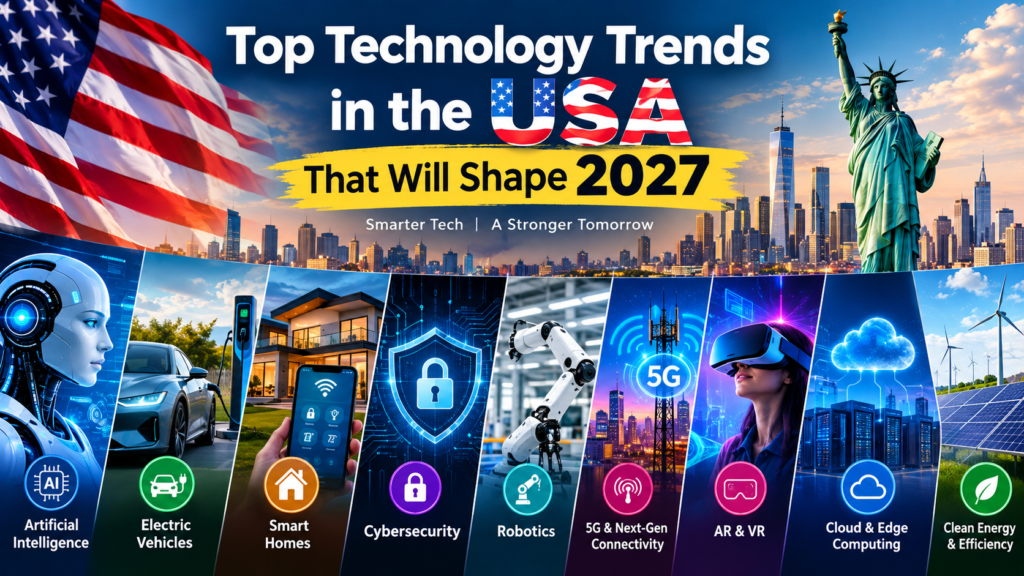
1. Artificial Intelligence Will Become Part of Everyday Life
Artificial intelligence, or AI, is expected to remain one of the biggest technology trends in the United States.
AI is already being used for customer service, content creation, search, healthcare research, education, business operations, and entertainment. In the coming years, AI assistants are likely to become more useful and more integrated into everyday digital experiences.
American businesses are also using AI to analyze information, automate repetitive tasks, personalize customer experiences, and improve productivity.
By 2027, AI may become less of a separate technology and more of a standard feature built into the apps, websites, smartphones, and services people use every day.
2. AI-Powered Smartphones and Personal Devices
Smartphones are becoming more intelligent as manufacturers add AI-powered features directly to devices.
Future smartphones are expected to offer better voice assistants, photo editing, translation, personalization, security, and productivity tools. Instead of sending every task to the cloud, some AI features can also run directly on devices.
This development could make smartphones more helpful while improving speed and privacy for certain applications.
For American consumers, the next generation of smartphones may feel less like simple communication devices and more like personal AI assistants.
3. Cybersecurity Will Become Even More Important
As Americans spend more time online, protecting personal and business information will become increasingly important.
Cyberattacks, scams, data breaches, and identity theft can affect individuals, companies, and government organizations. At the same time, AI is giving cybersecurity teams new tools to detect unusual activity and respond to threats faster.
By 2027, stronger authentication, improved threat detection, biometric security, and AI-powered cybersecurity tools are likely to become increasingly common.
Consumers should also continue using strong passwords, multi-factor authentication, software updates, and other basic security practices.
4. Electric Vehicles Will Continue to Grow
Electric vehicles are another major technology trend in the United States.
EV technology continues to improve through better batteries, charging infrastructure, software, and vehicle design. Automakers are investing in new electric models across different vehicle categories.
As charging networks expand and battery technology develops, electric vehicles could become increasingly practical for American drivers.
The future of transportation may also include more connected vehicles that can communicate with apps, charging networks, and other digital services.
5. Smart Homes Will Become Smarter
Smart home technology is becoming increasingly popular across the USA.
Smart thermostats, security cameras, doorbells, lights, locks, appliances, and voice assistants already allow homeowners to control many parts of their homes digitally.
AI could make these systems more useful by allowing devices to understand routines and automate everyday tasks.
For example, a smart home could adjust temperature settings, manage lighting, monitor security, and provide alerts based on household activity.
The goal is not simply to add more connected devices, but to create homes that are more convenient, efficient, and responsive.
6. Robotics Will Expand Beyond Factories
Robotics has traditionally been associated with manufacturing, but its role is expanding.
Robots are increasingly being developed for warehouses, logistics, healthcare, agriculture, restaurants, and other industries. Advances in AI and computer vision are helping machines understand and respond to their environments more effectively.
In the United States, businesses may increasingly use robots for repetitive or physically demanding tasks.
This does not necessarily mean that robots will replace humans everywhere. Instead, many workplaces may use humans and machines together, with robots handling repetitive tasks while employees focus on decision-making, creativity, and customer interaction.
7. 5G and Next-Generation Connectivity
Fast and reliable connectivity will remain essential as more devices become connected.
5G networks are already supporting smartphones, connected vehicles, smart cities, industrial systems, and other technologies. Future improvements in wireless connectivity could provide faster communication and better support for connected devices.
Better connectivity can also help businesses adopt technologies such as remote collaboration, augmented reality, connected machinery, and real-time data services.
For consumers, faster networks can improve streaming, gaming, video calls, and other digital experiences.
8. Augmented Reality and Virtual Reality Will Evolve
Augmented reality (AR) and virtual reality (VR) are expected to continue developing in the United States.
VR can create immersive digital environments for gaming, training, education, and entertainment. AR can place digital information and objects into the real world.
As hardware becomes more comfortable and software improves, these technologies could find more practical uses beyond gaming.
Businesses may use immersive technology for employee training, product demonstrations, virtual experiences, and remote collaboration.
9. Cloud Computing and Edge Computing Will Grow
Cloud computing has become an important part of modern American businesses.
Companies use cloud platforms to store information, run applications, analyze data, and support remote work. As AI and connected devices grow, businesses will also need faster ways to process large amounts of information.
This is where edge computing can become increasingly important. Instead of sending every piece of data to a distant data center, some information can be processed closer to where it is created.
Together, cloud and edge computing can support faster and more flexible digital services.
10. Technology Will Focus More on Energy Efficiency
Technology is not only becoming more powerful; it is also being designed with energy efficiency in mind.
Data centers, AI systems, electric vehicles, smart buildings, and electronic devices all require energy. As technology adoption increases, businesses and governments are looking for ways to reduce energy consumption and improve efficiency.
Future innovations may focus on more efficient processors, better batteries, renewable energy integration, and smarter energy management.
This trend could be particularly important as AI and data-intensive technologies continue to grow.
How These Trends Could Affect Americans
The technology trends shaping 2027 will affect more than just the technology industry.
Consumers may use AI assistants for everyday tasks, drive more electric vehicles, live in smarter homes, and rely on stronger digital security. Businesses may automate more operations, use AI for decision-making, and adopt robotics and cloud technologies.
At the same time, these developments will create new questions about privacy, cybersecurity, employment, digital skills, and responsible use of AI.
Learning how these technologies work will therefore become an increasingly valuable skill.
Final Thoughts
The technology landscape in the United States is entering an exciting period. Artificial intelligence, electric vehicles, smart homes, robotics, cybersecurity, advanced connectivity, and immersive technology are all expected to influence everyday life as we move toward 2027.
Not every prediction will happen at the same speed, but one thing is clear: technology will continue to change how Americans live and work.
For consumers and businesses, staying informed about these developments can make it easier to understand new opportunities, prepare for challenges, and take advantage of the technologies shaping the future.