

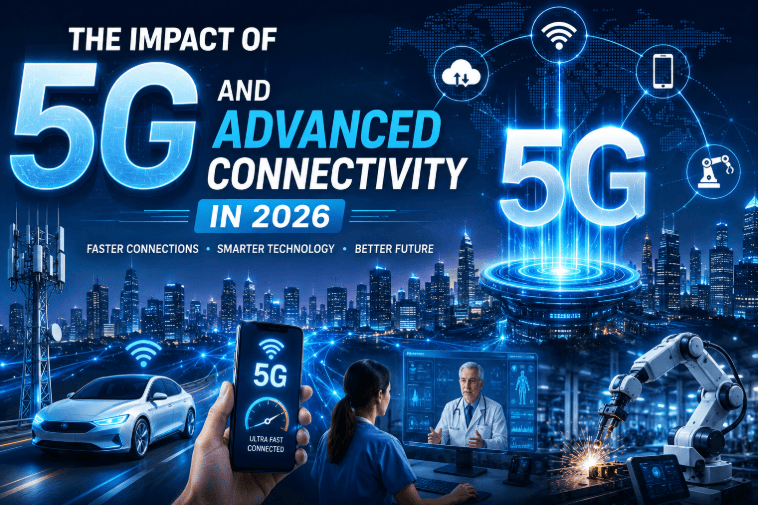
5G has moved far beyond being simply the next generation of mobile internet. In 2026, advanced connectivity is becoming an important foundation for artificial intelligence, smart devices, connected vehicles, industrial automation, cloud services, and digital businesses.
The development of 5G Standalone, 5G-Advanced, private networks, satellite connectivity, and AI-powered network technologies is changing how people and businesses connect to digital services. According to the GSMA, mobile technologies and services generated an estimated $7.6 trillion in economic value globally in 2025, equal to 6.4% of global GDP, and the industry’s economic contribution is projected to reach $11.3 trillion by 2030.
As connectivity becomes faster, more reliable, and more intelligent, its impact can be seen across almost every part of the modern economy.
What Is 5G and Advanced Connectivity?
5G is a mobile network technology designed to provide faster data speeds, lower latency, greater network capacity, and support for a much larger number of connected devices.
Advanced connectivity goes beyond traditional 5G. It includes technologies such as 5G Standalone, 5G-Advanced, private 5G networks, satellite-based connectivity, edge computing, and programmable network services.
The industry is also moving toward more advanced 5G capabilities. 3GPP Release 18 introduced the first major set of 5G-Advanced improvements, including enhancements related to AI and machine learning, network energy efficiency, positioning, IoT, and satellite access.
These developments are helping transform mobile networks from basic communication infrastructure into intelligent digital platforms.
Faster and More Reliable Mobile Internet
One of the most visible benefits of 5G is improved mobile connectivity.
For consumers, faster networks can make activities such as video streaming, cloud gaming, video calling, large file transfers, and online collaboration smoother.
However, speed is only one part of the 5G advantage. Modern networks are also designed to provide more consistent performance and support large numbers of devices simultaneously.
This becomes particularly important in crowded locations such as stadiums, airports, shopping centers, concerts, and city centers where thousands of people may connect to the network at the same time.
5G and Artificial Intelligence
Artificial intelligence is becoming closely connected with advanced mobile networks.
AI applications increasingly depend on continuous communication between devices, cloud platforms, and data centers. Smartphones, AI wearables, connected vehicles, cameras, robots, and industrial machines can generate and exchange huge amounts of information.
5G can help provide the connectivity required for these applications.
The relationship also works in the opposite direction. AI can help telecom companies optimize networks, identify problems, manage traffic, improve energy efficiency, and automate network operations.
The GSMA reports that the mobile industry is increasingly combining AI with 5G, open APIs, and digital platforms as operators look for new services and revenue opportunities.
The Growth of 5G-Advanced
In 2026, attention is increasingly shifting from basic 5G deployment toward 5G-Advanced.
5G-Advanced is designed to improve the capabilities of existing 5G networks and support more demanding applications. These include AI-powered services, immersive experiences, advanced IoT, robotics, improved positioning, and more efficient network operations.
The technology can also improve uplink performance, which is increasingly important as people and businesses upload more video, data, and AI-generated content.
China provides one example of this development. The GSMA reported that 5G-Advanced had expanded to more than 330 cities in mainland China by the end of 2025, with commercial services increasingly focused on enhanced uplink, capacity, and digital experiences.
5G in Smart Cities
Advanced connectivity is also helping cities become more intelligent.
Smart city systems can use connected sensors and devices to monitor traffic, public transportation, environmental conditions, energy consumption, and infrastructure.
For example, connected traffic systems can collect information about road conditions and vehicle movement. This data can then be analyzed to improve traffic management.
Smart lighting systems can also adjust lighting based on usage and environmental conditions, potentially reducing unnecessary energy consumption.
As more devices become connected, reliable networks become an increasingly important part of smart city infrastructure.
The Impact on Businesses
Businesses are among the biggest potential beneficiaries of advanced connectivity.
Factories can use private 5G networks to connect robots, sensors, cameras, machines, and workers. These networks can support real-time communication and help companies create more automated production environments.
Retail businesses can use connected devices for inventory management, customer experiences, logistics, and digital payments.
Agricultural companies can also use connected sensors to monitor soil conditions, weather information, equipment, and crops.
The development of private networks is particularly important because businesses can design connectivity around their specific operational requirements.
The GSMA identifies private networks, 5G-Advanced, AI, and non-terrestrial networks as major areas of mobile innovation moving toward real-world deployment.
Connected Vehicles and Transportation
Transportation is another industry where advanced connectivity could have a major impact.
Connected vehicles can communicate with cloud services, infrastructure, and other systems to provide drivers and operators with real-time information.
5G can support applications involving navigation, vehicle diagnostics, fleet management, entertainment, and intelligent transportation systems.
Public transportation can also benefit from better connectivity. Buses, trains, and logistics fleets can use connected systems to monitor locations, routes, maintenance requirements, and operational performance.
As autonomous and semi-autonomous vehicle technologies develop, reliable low-latency connectivity may become increasingly valuable.
Better Experiences for Sports and Entertainment
Sports and entertainment venues are becoming increasingly connected.
Modern stadiums can use advanced networks to support high-quality live streaming, instant video uploads, mobile applications, digital ticketing, connected cameras, and interactive fan experiences.
5G-Advanced can be particularly useful for high-uplink environments where thousands of people may simultaneously upload photos, videos, and live content.
The technology can also support immersive experiences such as augmented reality and other interactive applications.
This could allow fans to access real-time statistics, alternative camera views, player information, and personalized content directly from their devices.
Healthcare and Remote Services
Advanced connectivity could also improve healthcare services.
Connected medical devices can transmit information to healthcare systems, while remote communication can help doctors and specialists interact with patients in different locations.
In hospitals, connected equipment can help staff monitor devices and patient information more efficiently.
Remote services are particularly valuable in areas where access to specialized professionals may be limited.
However, healthcare connectivity requires strong security, privacy protections, and reliable infrastructure because medical information is highly sensitive.
Satellite Connectivity and Remote Areas
One of the most important developments in advanced connectivity is the combination of mobile networks with satellite technologies.
Traditional terrestrial networks cannot reach every location. Rural communities, remote regions, oceans, and disaster zones can present major connectivity challenges.
Satellite and non-terrestrial networks can help extend connectivity to places where conventional infrastructure is difficult or expensive to deploy.
3GPP’s 5G-Advanced work includes further integration of satellite access, helping create closer connections between terrestrial and non-terrestrial networks.
This could play an important role in expanding digital access globally.
5G and the Future of Remote Work
The growth of advanced connectivity is also changing how people work.
High-quality mobile internet allows employees to communicate, access cloud applications, participate in video meetings, and collaborate from different locations.
For businesses with distributed teams, reliable connectivity can reduce dependence on traditional office infrastructure.
As AI-powered workplace applications become more common, connectivity will become even more important because employees may rely on cloud-based AI assistants, real-time collaboration platforms, and connected devices throughout the working day.
Challenges of Advanced Connectivity
Despite its benefits, 5G and advanced connectivity also face challenges.
Building new networks requires significant investment in spectrum, infrastructure, equipment, and fiber connections. Rural and remote areas can be particularly difficult to serve economically.
Cybersecurity is another major concern. As billions of devices become connected, the potential number of targets for cyberattacks increases.
There is also a digital divide. The GSMA reported in 2026 that although 96% of the world’s population lives within mobile broadband coverage, more than three billion people remain unconnected, showing that coverage alone does not guarantee meaningful digital access.
Affordability, digital skills, device availability, and local infrastructure all influence whether people can actually benefit from advanced connectivity.
What Comes Next?
The future of connectivity will likely involve deeper integration between 5G, AI, cloud computing, edge computing, satellite networks, and connected devices.
The industry is already researching the next generation of mobile technology, including 6G. However, 5G-Advanced and advanced 5G Standalone networks are expected to remain important during the second half of the decade.
According to the GSMA’s 2026 outlook, future mobile networks will need additional spectrum as connectivity expands beyond smartphones to industrial machines, connected vehicles, and other devices.
This means the future of connectivity will not simply be about achieving faster download speeds. It will be about creating networks that are intelligent, flexible, reliable, secure, and capable of supporting entirely new digital services.
Conclusion
The impact of 5G and advanced connectivity in 2026 extends far beyond smartphones.
From artificial intelligence and smart cities to connected vehicles, private industrial networks, healthcare, sports, entertainment, and satellite communication, advanced connectivity is becoming an essential part of the digital economy.
As 5G-Advanced develops and businesses continue adopting AI-powered technologies, connectivity will become increasingly important to everyday life and economic growth.
The next stage of mobile technology is therefore not just about faster internet. It is about building a more connected digital world where people, machines, businesses, and intelligent systems can communicate more efficiently than ever before.