
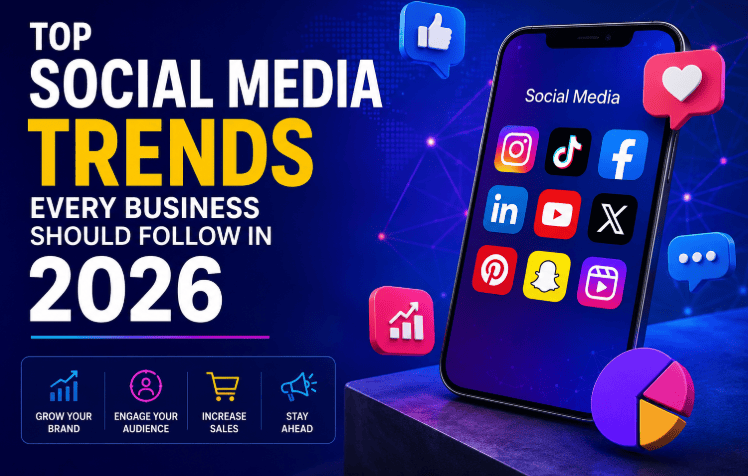
Social media continues to play an important role in how businesses connect with customers, build brand awareness, and generate sales. In 2026, social media marketing is becoming more competitive as platforms introduce new features, artificial intelligence changes content creation, and audiences increasingly prefer authentic and engaging experiences.
Businesses that want to stay ahead need to understand the latest social media trends and adapt their strategies accordingly. From AI-powered content to short-form videos and creator marketing, several trends are shaping the future of digital marketing.
1. AI-Powered Social Media Marketing
Artificial intelligence is one of the biggest trends in social media marketing in 2026. Businesses are using AI tools to generate content ideas, write captions, analyze audiences, create images, and improve marketing campaigns.
AI can also help businesses understand which types of content perform best. Instead of spending hours analyzing data manually, marketers can use AI-powered tools to identify patterns and make faster decisions.
However, businesses should not rely completely on AI-generated content. Human creativity, brand personality, and authentic communication are still important for building trust with audiences.
2. Short-Form Video Continues to Grow
Short-form videos remain one of the most effective ways to capture attention on social media. Platforms such as Instagram, TikTok, YouTube, and Facebook continue to prioritize engaging video content.
Businesses can use short videos to:
- Introduce products and services
- Share quick tutorials
- Answer customer questions
- Show behind-the-scenes content
- Share industry tips
- Present customer testimonials
The key is to create videos that provide value quickly. A strong opening, clear message, and simple call to action can help businesses improve engagement.
3. Authentic Content Is More Important
Consumers are becoming more aware of overly edited and promotional content. In 2026, authentic social media content can help businesses create stronger relationships with their audiences.
Instead of making every post look like a traditional advertisement, brands can show the people and processes behind their businesses.
For example, a company could share employee stories, product development, customer experiences, or behind-the-scenes videos. This type of content can make a brand feel more human and relatable.
4. Social Commerce Is Becoming a Major Opportunity
Social media is no longer only a place for discovering products. It is increasingly becoming part of the shopping journey.
Businesses can use social platforms to showcase products, answer questions, build trust, and direct customers toward purchases. Product demonstrations, reviews, tutorials, and user-generated content can all support social commerce.
For e-commerce businesses, connecting social media marketing with an easy purchasing experience can help reduce the distance between discovering a product and buying it.
5. Creator and Influencer Marketing
Creator marketing continues to be an important strategy for businesses in 2026. However, brands are increasingly looking beyond follower counts.
A creator with a smaller but highly engaged audience can sometimes provide more meaningful results than a large account with low engagement.
Businesses should consider factors such as:
- Audience relevance
- Engagement quality
- Content style
- Brand reputation
- Niche expertise
- Previous collaborations
The best creator partnerships should feel natural rather than like traditional advertisements.
6. User-Generated Content Builds Trust
User-generated content, or UGC, is another powerful social media trend. This includes reviews, customer photos, videos, testimonials, and other content created by customers.
UGC can provide social proof and show potential customers how real people use a product or service.
Businesses can encourage UGC by asking customers to share their experiences, creating branded campaigns, or featuring customer content on their social media pages.
7. Social Search Is Growing
People increasingly use social media platforms to discover businesses, products, services, tutorials, and recommendations.
This means businesses should think about social media content in a similar way to search engine optimization.
Using relevant keywords in captions, video titles, descriptions, profiles, and hashtags can make content easier for users to discover.
For example, a beauty brand could create content around searches such as “skincare routine,” “best skincare tips,” or “how to improve skin hydration.”
8. Personalized Content Will Stand Out
Audiences do not all have the same interests. Businesses that understand their different customer groups can create more relevant content.
Personalization can involve creating different content for different audiences, using customer insights to guide campaigns, or recommending products based on customer interests.
The goal is to make people feel that the content is relevant to them instead of presenting the same generic message to everyone.
9. Community Building Over Follower Counts
Having thousands of followers does not automatically mean a business has a strong social media presence.
In 2026, businesses should focus more on building an active community. Responding to comments, answering questions, starting conversations, and creating valuable discussions can help strengthen relationships with customers.
A smaller audience that actively engages with a brand can be more valuable than a large audience that rarely interacts.
10. Social Media Analytics Will Drive Better Decisions
Data is essential for improving social media performance. Businesses should regularly monitor metrics such as reach, engagement, clicks, conversions, video views, and audience growth.
Analytics can help businesses understand:
- Which content attracts the most attention
- When audiences are most active
- Which platforms generate the best results
- What type of content drives website traffic
- Which campaigns lead to conversions
Instead of simply posting more content, businesses should use performance data to create smarter strategies.
11. Interactive Content Will Increase Engagement
Interactive content can encourage users to participate instead of simply scrolling past a post.
Businesses can use polls, quizzes, questions, challenges, live sessions, and interactive stories to encourage participation.
For example, a fashion business could ask followers to choose between two styles, while a technology company could create a simple quiz about new technology trends.
Interactive content can make social media profiles more engaging and help businesses learn more about their audiences.
12. Video Storytelling Will Become More Important
People often remember stories better than direct advertisements. Businesses can use storytelling to explain their mission, introduce their team, share customer experiences, or demonstrate how their products solve problems.
A good social media story does not always need a large production budget. Simple, authentic videos can be highly effective when they communicate a clear message.
How Businesses Can Prepare for Social Media Trends in 2026
Following every trend is not necessary. Businesses should focus on trends that match their audience, goals, and industry.
A practical strategy is to start by identifying the platforms where the target audience spends the most time. Then, businesses can experiment with different content formats and measure the results.
For example, a business could combine short-form videos, educational posts, customer content, creator partnerships, and AI-assisted content planning. After several weeks, the business can review its analytics and invest more time in the strategies producing the strongest results.
Consistency is also important. Social media growth usually requires regular publishing, audience interaction, testing, and continuous improvement.
Final Thoughts
Social media marketing in 2026 is becoming more focused on technology, authenticity, personalization, community, and meaningful engagement. AI is changing how businesses create and analyze content, while short-form video, creator marketing, social commerce, and user-generated content continue to influence how consumers discover brands.
Businesses that adapt to these trends while maintaining an authentic brand voice can create stronger relationships with their audiences and improve their digital marketing performance.
The most successful strategy is not simply to follow every new trend. Instead, businesses should test relevant strategies, study their audience, analyze results, and continuously improve their social media marketing approach.