
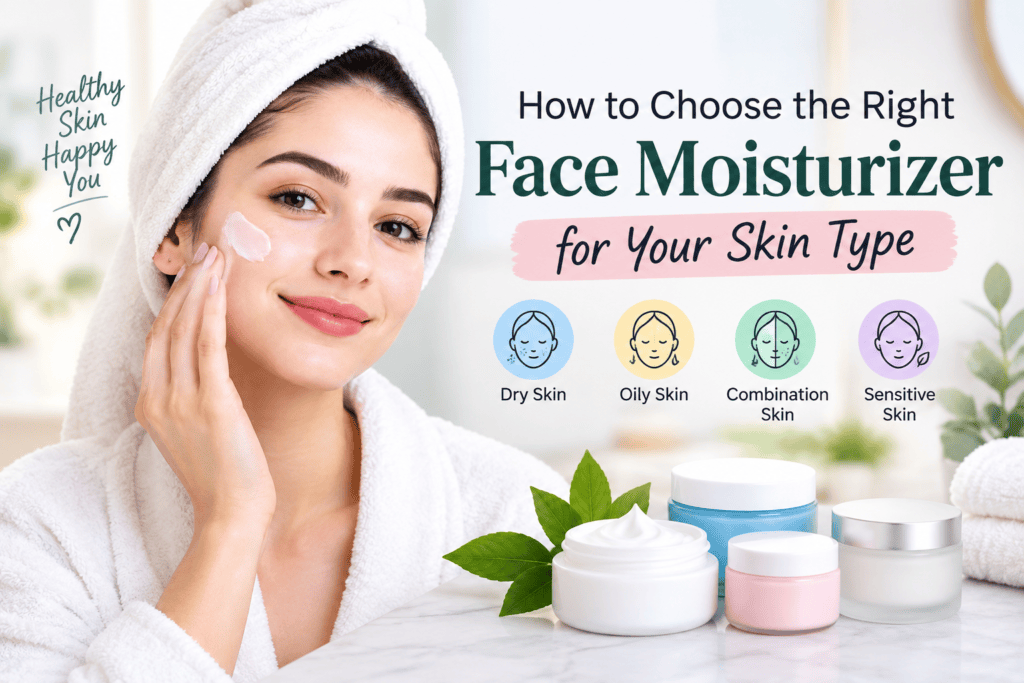
Choosing the right face moisturizer can make a big difference in a simple skincare routine. A good moisturizer helps support the skin barrier, reduce dryness, and keep your skin feeling comfortable. However, not every moisturizer works the same way for everyone.
Your skin type, climate, ingredients, and personal skincare needs can all affect which moisturizer is suitable for you. Using a product that is too heavy may feel uncomfortable on oily skin, while a very lightweight formula may not provide enough moisture for dry skin.
In this guide, we will explain how to choose the right face moisturizer for your skin type, what ingredients to look for, common mistakes to avoid, and how to build a simple moisturizing routine.
Why Is Face Moisturizer Important?
Moisturizer is an important part of many skincare routines because it helps maintain the skin’s moisture balance and supports the skin barrier.
The skin barrier helps protect the outer layer of your skin from environmental factors and excessive moisture loss. When skin becomes dry, it can feel tight, rough, or uncomfortable.
Regular moisturizing can help your skin feel:
- Softer and smoother
- More comfortable
- Less dry or tight
- Better hydrated
- More supported against moisture loss
A moisturizer does not need to be complicated. The goal is to find a formula that feels comfortable and works well with your skin type.
How to Identify Your Skin Type
Before choosing a moisturizer, it helps to understand your skin type. Most people generally describe their skin as dry, oily, combination, or normal. Some people also have sensitive skin.
1. Dry Skin
Dry skin often feels tight or rough, especially after cleansing. It may also appear flaky in some areas.
If you have dry skin, look for moisturizers with ingredients that help attract and retain water or reduce moisture loss.
Useful ingredients may include:
- Hyaluronic acid
- Glycerin
- Ceramides
- Squalane
- Shea butter
Cream-based moisturizers can sometimes feel more comfortable on dry skin than very lightweight gels.
2. Oily Skin
Oily skin tends to produce more sebum and may look shiny, particularly around the forehead, nose, and chin.
Having oily skin does not mean you should automatically skip moisturizer. A lightweight moisturizer can help keep your routine comfortable without adding a heavy feeling.
Look for:
- Lightweight lotions
- Gel moisturizers
- Non-greasy formulas
- Products labeled non-comedogenic when appropriate
Avoid choosing a product simply because it says “for oily skin.” Always check whether the texture and ingredients suit your individual skin.
3. Combination Skin
Combination skin can have both oily and dry areas. For example, the T-zone may become oily while the cheeks feel normal or dry.
A lightweight lotion or gel-cream can be a useful starting point. You can also adjust how much moisturizer you apply to different areas of your face.
For example, you might use a little more product on areas that feel dry and less on areas that become oily.
4. Normal Skin
Normal skin generally has a relatively balanced feel and does not consistently experience excessive dryness or oiliness.
If you have normal skin, you have more flexibility when choosing a moisturizer. A lightweight lotion, cream, or gel-cream may work depending on your preference.
Focus on a formula that feels comfortable and fits your daily routine.
5. Sensitive Skin
Sensitive skin may react easily to certain skincare products. You may notice redness, stinging, burning, or discomfort after using particular ingredients or products.
If your skin is sensitive, consider choosing a simple moisturizer with fewer potential irritants. Fragrance-free products can be a useful option for people who find fragrance irritating.
Look for gentle ingredients such as:
- Ceramides
- Glycerin
- Squalane
- Colloidal oatmeal
If a product causes persistent irritation, stop using it and consider talking with a dermatologist.
What Ingredients Should You Look for in a Face Moisturizer?
Understanding common skincare ingredients can make shopping for a moisturizer much easier.
Hyaluronic Acid
Hyaluronic acid is a humectant, meaning it helps attract and hold water. It is commonly included in lightweight hydrating products.
It can be useful for people who want hydration without a heavy texture.
Glycerin
Glycerin is another common humectant. It helps attract water and is widely used in moisturizers.
Because it is found in many formulations, it can be a simple ingredient to look for when choosing a hydrating product.
Ceramides
Ceramides are lipids naturally found in the skin barrier. Moisturizers containing ceramides are commonly used to support the skin barrier and reduce moisture loss.
They can be particularly useful when skin feels dry or when the barrier feels compromised.
Squalane
Squalane is an emollient ingredient used in many skincare products. It can help give moisturizers a smoother feel and help soften the skin.
Shea Butter
Shea butter is a richer emollient that can be found in creams designed for dry skin. Because it can feel heavier, people with oily skin may prefer lighter alternatives.
How to Choose Moisturizer Texture
The texture of a moisturizer can be just as important as its ingredients.
Gel Moisturizer
Gel moisturizers are generally lightweight and can feel refreshing on the skin.
They may be a good option for people who prefer a light texture, especially in warm or humid weather.
Lotion
Lotions usually have a light-to-medium texture and can work well for many skin types.
They are often a practical choice if you want hydration without a very heavy cream.
Cream
Creams tend to be richer than lotions and gels. They may be more comfortable for people with dry skin or during colder weather.
Ointment or Balm
Very rich formulas can provide more protection against moisture loss. They may be useful for particularly dry areas, although they can feel too heavy for some people.
How to Choose a Moisturizer for Oily Skin
If your skin becomes oily during the day, you may prefer a lightweight moisturizer.
Look for a formula that:
- Feels lightweight
- Absorbs comfortably
- Does not leave an excessively greasy finish
- Works well under sunscreen
- Is suitable for your individual skin
A gel or lightweight lotion can be a good starting point.
Remember that oily skin still needs hydration. Skipping moisturizer completely may make your skincare routine less comfortable.
How to Choose a Moisturizer for Dry Skin
For dry skin, look for a moisturizer that provides lasting comfort and helps reduce moisture loss.
Cream-based formulas may be preferable if your skin frequently feels tight or rough.
Ingredients such as glycerin, ceramides, hyaluronic acid, and squalane can be useful depending on the formulation.
You can also apply moisturizer shortly after cleansing while the skin is still slightly damp, which can help lock in moisture.
How to Choose a Moisturizer for Combination Skin
Combination skin can require a balanced approach.
A lightweight moisturizer can be applied across the face, while slightly more product can be used on areas that feel dry.
You do not necessarily need two different moisturizers. Start with one comfortable formula and adjust the amount according to how different areas of your skin feel.
How to Choose a Moisturizer for Sensitive Skin
When your skin is sensitive, keeping your routine simple can make it easier to identify products that work well for you.
Consider:
- Fragrance-free formulas
- Simple ingredient lists
- Gentle moisturizing ingredients
- Products designed for sensitive skin
Before applying a new product to your entire face, consider testing a small amount on a limited area first. If you experience significant irritation, discontinue use.
What Does “Non-Comedogenic” Mean?
You may notice the term non-comedogenic on some skincare products.
It generally means the product is formulated with the intention of being less likely to clog pores. However, everyone’s skin can respond differently to cosmetic products.
If you are prone to clogged pores or breakouts, a non-comedogenic moisturizer may be worth considering.
How Often Should You Use Face Moisturizer?
Many people use moisturizer once or twice a day, depending on their skincare routine and skin needs.
A simple routine could be:
Morning:
- Gentle cleanser
- Moisturizer
- Broad-spectrum sunscreen
Evening:
- Cleanser
- Moisturizer
If your skin feels comfortable with this routine, there may be no need to add many additional products.
How Much Moisturizer Should You Apply?
You do not need a large amount of moisturizer.
Start with a small amount and spread it evenly across your face and neck if desired. You can add a little more to areas that feel particularly dry.
Using too much product can make the skin feel unnecessarily heavy, especially if you have oily or combination skin.
Common Moisturizer Mistakes to Avoid
Choosing a moisturizer is not only about finding the right ingredients. Your application habits also matter.
Mistake 1: Skipping Moisturizer Because You Have Oily Skin
Oily skin can still benefit from hydration. Instead of skipping moisturizer, try a lighter formula.
Mistake 2: Choosing Products Based Only on Marketing
Words such as “glowing,” “premium,” or “deep hydration” do not tell you everything about how a product will work for your skin.
Read the ingredient list and consider the texture.
Mistake 3: Using a Very Heavy Product on Oily Skin
A rich cream may feel uncomfortable if your skin already becomes very oily.
Mistake 4: Using a Very Lightweight Product on Extremely Dry Skin
A lightweight gel may not provide enough comfort for very dry skin.
Mistake 5: Changing Products Too Frequently
Trying multiple products at the same time can make it difficult to understand which product is helping or irritating your skin.
Try to introduce new skincare products gradually.
How Climate Can Affect Your Moisturizer Choice
Your moisturizer needs may change with the weather.
In hot and humid conditions, you may prefer a lightweight gel or lotion. During cold or dry weather, a richer cream may feel more comfortable.
If you live in a hot climate, choosing a moisturizer that feels light and comfortable can make it easier to maintain your skincare routine consistently.
Can You Use the Same Moisturizer in the Morning and at Night?
Yes, you can often use the same moisturizer both morning and evening if it works well for your skin.
However, your morning routine should also include sunscreen. Moisturizer and sunscreen serve different purposes.
A moisturizer helps hydrate and support the skin, while sunscreen helps protect exposed skin from ultraviolet radiation.
Moisturizer vs. Face Oil: What’s the Difference?
Moisturizers and face oils are not exactly the same.
A moisturizer is generally formulated to provide hydration and support the skin barrier through a combination of ingredients.
Face oils are mainly oil-based and can help soften the skin and reduce moisture loss.
You do not necessarily need both. A simple moisturizer may be enough for many skincare routines.
How to Read a Moisturizer Label
When shopping for a moisturizer, don’t focus only on the front of the package.
Check:
1. Skin type:
Does the product match your skin type?
2. Ingredients:
Does it contain ingredients suitable for your needs?
3. Texture:
Is it a gel, lotion, cream, or richer formula?
4. Fragrance:
If your skin is sensitive to fragrance, consider a fragrance-free option.
5. Non-comedogenic claim:
If clogged pores are a concern, this may be useful to consider.
A Simple Moisturizer Routine for Beginners
If you are new to skincare, you do not need a complicated routine.
Morning Routine
Step 1: Clean your face with a gentle cleanser.
Step 2: Apply your moisturizer.
Step 3: Apply broad-spectrum sunscreen before going outside.
Night Routine
Step 1: Clean your face.
Step 2: Apply moisturizer evenly.
That’s it.
Once you understand how your skin responds, you can decide whether additional skincare products are necessary.
Frequently Asked Questions
What is the best moisturizer for dry skin?
A richer cream containing moisturizing and barrier-supporting ingredients such as glycerin and ceramides may be suitable for dry skin. Individual results can vary.
What is the best moisturizer for oily skin?
A lightweight gel or lotion may be comfortable for oily skin. Look for a formula that does not leave an excessively greasy feeling.
Should oily skin use moisturizer?
Yes. Oily skin can still become dehydrated, and moisturizer can be part of a balanced skincare routine.
Can I use moisturizer every day?
For many people, daily moisturizing is a normal part of skincare. Choose a product that works comfortably with your skin type.
Should I apply moisturizer before sunscreen?
In a typical morning routine, moisturizer is applied before sunscreen. Sunscreen should be the final skincare step before makeup, when applicable.
How do I know if a moisturizer is working for me?
Your skin should generally feel comfortable, hydrated, and not excessively greasy or irritated after use. If a product repeatedly causes irritation, discontinue it.
Final Thoughts
Choosing the right face moisturizer does not have to be complicated. Start by identifying your skin type and then consider the moisturizer’s texture, ingredients, and how your skin responds to it.
For dry skin, richer creams and barrier-supporting ingredients may be useful. For oily skin, lightweight gels or lotions may feel more comfortable. Combination skin may benefit from a balanced formula, while people with sensitive skin may prefer simple, fragrance-free products.
Most importantly, remember that skincare is personal. A moisturizer that works well for one person may not work the same way for another. Keep your routine simple, introduce new products gradually, and pay attention to how your skin responds.
With the right moisturizer and a consistent routine, you can make daily skincare simpler and more comfortable.
Disclaimer: This article provides general skincare information and is not a substitute for professional medical advice. If you have persistent irritation, severe dryness, or an ongoing skin condition, consider consulting a qualified dermatologist.