
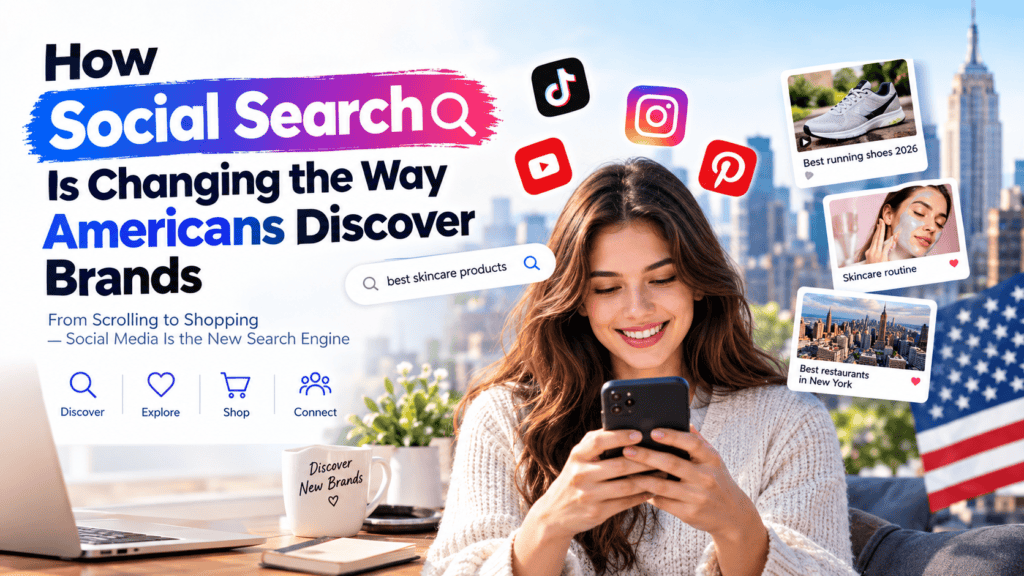
For years, Google has been the first place people go when they want to find information, products, restaurants, services, or businesses. But the way Americans discover brands online is changing. Social media platforms are becoming powerful search and discovery tools, especially for younger consumers who want quick answers, visual content, reviews, recommendations, and real experiences.
Instead of searching only on traditional search engines, many users now turn to platforms such as TikTok, Instagram, YouTube, Facebook, and Pinterest to discover products and brands.
This shift is known as social search, and it is becoming an important part of digital marketing in the United States.
For brands, this means that having a website and ranking on Google may no longer be enough. Businesses also need to make their content easy to discover through social media searches.
What Is Social Search?
Social search is the process of using social media platforms to find information, products, services, brands, reviews, recommendations, and ideas.
For example, instead of searching Google for:
“Best skincare products for beginners”
an American consumer might search TikTok or Instagram for:
“Best skincare products 2026”
Similarly, someone looking for a restaurant might search:
“Best restaurants in New York”
directly on TikTok, Instagram, or YouTube.
Social platforms provide visual content and recommendations from creators, customers, and brands. This makes the discovery process feel more personal and interactive.
Social search is therefore becoming an important part of the modern customer journey.
Why Social Search Is Growing in the USA
There are several reasons why social search is becoming more popular among American consumers.
1. People Want Visual Answers
Traditional search results often provide links and text. Social media can provide videos, photos, demonstrations, tutorials, reviews, and user experiences.
For example, someone searching for a new pair of running shoes may prefer watching a short video showing how the shoes look and perform instead of reading several product pages.
Visual content can make product discovery faster and easier.
2. Consumers Trust Real Experiences
People often want to know what other customers think before buying something.
Social media makes it easy to find:
- Customer reviews
- Product demonstrations
- Unboxing videos
- Before-and-after content
- Tutorials
- Creator recommendations
- User-generated content
This type of content can help consumers understand how a product works in real life.
3. Younger Americans Are Comfortable Searching on Social Platforms
Younger consumers have grown up using social media as part of their everyday online experience.
For many users, platforms such as TikTok, Instagram, YouTube, and Pinterest are not only entertainment apps. They are also places to discover trends, products, restaurants, destinations, creators, and businesses.
This is encouraging brands to rethink how they approach online visibility.
How Americans Are Using Social Search to Discover Brands
Social search can influence almost every stage of the buying journey.
A consumer may first discover a brand through a short video. Then they may visit the brand’s profile, watch customer reviews, check comments, compare products, and eventually visit the company’s website.
This creates a discovery journey that can happen almost entirely inside social media.
For example:
TikTok video → Brand profile → Product reviews → Website → Purchase
Another consumer might discover a product through Instagram:
Instagram Reel → Creator recommendation → Comments → Brand page → Product page
This is why social media optimization is becoming increasingly important for businesses.
TikTok and the Rise of Social Discovery
TikTok has become one of the most influential platforms for short-form video discovery.
Users can discover products, businesses, trends, tutorials, and recommendations through videos appearing in their feeds or through searches.
A small business can potentially reach thousands of people with a useful or entertaining video without having a massive website or advertising budget.
For brands targeting American consumers, TikTok content can focus on:
- Product demonstrations
- Educational videos
- Quick tutorials
- Customer reviews
- Behind-the-scenes content
- Frequently asked questions
- Trending topics
- Problem-solving videos
The key is to create content that answers questions people are already asking.
Instagram Is Becoming More Search-Friendly
Instagram is also an important platform for brand discovery.
Users can search for businesses, products, creators, locations, hashtags, and topics. Reels and other visual content can introduce brands to people who do not already follow them.
Businesses should make their Instagram profiles clear and informative.
Important elements include:
- A descriptive username
- A clear profile name
- A useful bio
- Relevant keywords
- Accurate location information
- Descriptive captions
- Relevant hashtags
- High-quality visual content
Instead of treating Instagram as only a photo-sharing platform, businesses can use it as a searchable discovery channel.
YouTube Is More Than a Video Platform
YouTube has traditionally been one of the world’s largest video platforms, but it is also an important search engine.
Americans use YouTube to learn about products, compare services, watch tutorials, follow creators, and research buying decisions.
For brands, this creates an opportunity to produce longer educational content as well as short videos.
For example, a technology company could publish:
“5 AI Tools Small Businesses Should Try in 2026”
A beauty company could create:
“Simple Skincare Routine for Beginners”
A footwear business could publish:
“How to Choose the Right Running Shoes”
These videos can attract people who are actively looking for information.
The Importance of Keywords in Social Media
SEO is no longer limited to websites.
Keywords are becoming important across social media platforms as well.
Brands should naturally use relevant keywords in:
- Video titles
- Captions
- Descriptions
- Profile bios
- On-screen text
- Hashtags
- Spoken content
For example, instead of writing a caption such as:
“Check this out!”
a footwear brand could write:
“Best everyday sneakers for comfortable walking in 2026.”
The second caption provides much more context about the content.
However, brands should avoid stuffing posts with unnecessary keywords. Social content should remain natural and useful.
User-Generated Content Can Improve Brand Discovery
One of the biggest advantages of social media is user-generated content, often called UGC.
UGC is content created by customers rather than the brand itself.
Examples include:
- Customer videos
- Product reviews
- Unboxing videos
- Customer photos
- Tutorials
- Testimonials
- Before-and-after posts
UGC can make a brand feel more authentic.
For example, a customer showing how they use a product in everyday life may influence another person more effectively than a traditional advertisement.
Brands can encourage customers to create content by offering simple prompts, creating branded hashtags, or featuring customer posts on their social profiles.
Influencers and Creators Are Changing Brand Discovery
Creators also play a major role in social search and product discovery.
Consumers often follow creators because they trust their opinions, expertise, personality, or experience.
A recommendation from a relevant creator can introduce a brand to an entirely new audience.
However, brands do not always need to work with celebrities.
Micro-influencers can be valuable because they often have smaller but highly engaged communities.
For example, a local fitness creator in the United States may be a better partner for a running-shoe company than a general entertainment celebrity.
The most important factor is relevance.
Social Search and Local Businesses
Social search is also important for local businesses in America.
Restaurants, salons, gyms, clothing stores, beauty businesses, hotels, and other local companies can use social media to attract nearby customers.
A local restaurant, for example, can create videos showing:
- Popular menu items
- Restaurant atmosphere
- Customer experiences
- Special offers
- Behind-the-scenes cooking
- Location information
Someone searching for a restaurant in their city may discover the business through social content before ever visiting its website.
This makes local social media optimization especially valuable.
Social Commerce and Product Discovery
Social search is closely connected to social commerce.
Consumers can discover products through videos, creators, advertisements, recommendations, and brand pages and then move directly toward purchasing.
This shortens the path between discovery and buying.
For e-commerce businesses, social media can therefore serve several purposes at once:
Discovery → Education → Trust → Consideration → Purchase
Businesses should make sure that their social profiles, product pages, and websites provide a consistent experience.
How AI Is Changing Social Search
Artificial intelligence is also influencing how social platforms organize and recommend content.
AI can help platforms understand:
- What a video is about
- What users are interested in
- Which content is relevant
- What products may interest users
- Which creators match specific interests
For marketers, this means content should be clear and easy for both users and platforms to understand.
Businesses can use AI tools to help with brainstorming, research, captions, content ideas, and video scripts. However, human creativity and authentic experiences remain important.
Simply generating large amounts of generic AI content is unlikely to create a strong brand identity.
How Brands Can Optimize for Social Search
Businesses that want to benefit from social search should start with a clear strategy.
Use Search-Friendly Content
Create content around questions and topics your target customers are already searching for.
Instead of only promoting products, answer useful questions.
For example:
- How do I choose the right running shoes?
- What skincare products should beginners use?
- What are the best AI tools for small businesses?
- How can I improve my social media marketing?
- What should I know before buying a smartwatch?
This approach can attract users earlier in the buying journey.
Optimize Your Profiles
Your social profile should immediately explain what your business offers.
Use relevant words in your:
- Profile name
- Bio
- Description
- Category
- Location
Make it easy for users to understand who you are and what you provide.
Create Short-Form Videos
Short-form video remains one of the strongest formats for social discovery.
Businesses can create short videos that:
- Solve a problem
- Answer a question
- Demonstrate a product
- Explain a trend
- Share a useful tip
- Show a customer experience
The first few seconds are especially important because users can quickly scroll to the next piece of content.
Encourage Engagement
Comments, shares, saves, and other interactions can help create stronger connections with audiences.
Ask questions and encourage people to share their opinions.
For example:
“Which style would you choose?”
or:
“What is your biggest skincare mistake?”
Engagement can also provide businesses with valuable information about what their customers actually want.
Social Search vs. Traditional Search
Traditional search engines remain extremely important, but social search offers a different type of discovery.
Traditional search is often focused on finding information, websites, and direct answers.
Social search combines search with:
- Video
- Recommendations
- Community
- Entertainment
- Reviews
- Creators
- Trends
This makes social search particularly powerful for product discovery.
The future of digital marketing is therefore unlikely to be about choosing between Google and social media. Successful brands will increasingly need to understand both.
Common Social Search Mistakes Brands Should Avoid
Many businesses make mistakes when trying to optimize their social content.
Keyword Stuffing
Using the same keyword repeatedly can make content look unnatural.
Use keywords naturally and focus on helping the audience.
Only Posting Promotional Content
People do not want to see advertisements in every post.
Mix promotional content with educational, entertaining, and helpful posts.
Ignoring Comments
Comments can contain questions, complaints, suggestions, and buying signals.
Brands should monitor and respond to relevant comments.
Copying Every Trend
Not every viral trend fits every brand.
Businesses should choose trends that match their audience and identity.
Focusing Only on Followers
A large follower count does not automatically mean strong business results.
Reach, engagement, traffic, leads, conversions, and customer relationships can be more meaningful metrics.
The Future of Social Search in America
Social search is likely to become an increasingly important part of online discovery.
Consumers will continue using social platforms to find ideas, products, businesses, reviews, tutorials, and recommendations.
At the same time, social platforms are becoming more sophisticated at understanding video, images, text, and user intent.
This means brands will need to create content that is not only attractive but also useful and discoverable.
Businesses that start optimizing for social search today can build stronger visibility as consumer behavior continues to change.
Final Thoughts
Social search is changing the way Americans discover brands.
Consumers are increasingly using social platforms to research products, find recommendations, watch reviews, discover businesses, and follow trends.
For brands, this creates a major opportunity.
The most successful businesses will not simply post advertisements. They will create useful content that answers questions, demonstrates products, builds trust, and gives consumers a reason to follow and engage.
By combining traditional SEO with social media optimization, businesses can reach customers at more points throughout the modern buying journey.
The future of brand discovery is becoming more visual, social, interactive, and personalized—and businesses that adapt early can gain a meaningful advantage.