
Cyberattacks are becoming more sophisticated every year. From phishing emails and ransomware to identity theft and large-scale data breaches, cybercriminals are constantly developing new ways to target individuals, businesses, and government organizations. As digital systems become more important in everyday life, protecting sensitive information has become a major priority.
Artificial intelligence (AI) is now playing an increasingly important role in cybersecurity. Instead of relying only on traditional security tools and human analysts, organizations can use AI to analyze enormous amounts of data, identify unusual activity, detect potential threats, and respond to attacks much faster.
In the United States, where businesses rely heavily on cloud services, online payments, connected devices, and digital infrastructure, AI-powered cybersecurity is becoming an important part of modern security strategies.
But how exactly does AI fight cyberattacks? What benefits does it provide, and can AI also create new cybersecurity risks?
Let’s explore how artificial intelligence is changing cybersecurity in 2026 and what its future could look like.
What Is AI Cybersecurity?
AI cybersecurity refers to the use of artificial intelligence and machine learning technologies to identify, prevent, investigate, and respond to cyber threats.
Traditional cybersecurity systems often depend on predefined rules and known threat signatures. For example, a security system may block a file because it matches the characteristics of previously identified malware.
AI can take a different approach.
Instead of looking only for known threats, AI systems can analyze patterns in network traffic, user behavior, applications, devices, and other digital activity. When something appears unusual, the system can flag it for further investigation.
Machine learning can also improve over time by analyzing new data and learning from previous security incidents.
This makes AI particularly useful against modern cyberattacks that may change their behavior to avoid traditional security tools.
Why Cyberattacks Are Becoming More Difficult to Stop
Cybercriminals are no longer limited to simple viruses or obvious phishing emails. Modern attacks can involve multiple stages and may remain hidden inside a network for long periods.
Some common threats include:
- Phishing attacks
- Ransomware
- Malware
- Identity theft
- Credential theft
- Distributed denial-of-service attacks
- Business email compromise
- Supply-chain attacks
- Insider threats
- Cloud security attacks
- Social engineering
Attackers can also use automation and AI to create convincing messages, identify potential targets, and adapt their techniques.
This creates a difficult situation for cybersecurity teams. Security professionals may receive thousands or even millions of alerts, making it challenging to identify the most dangerous threats quickly.
AI can help by processing large amounts of information and prioritizing suspicious activity.
How Artificial Intelligence Detects Cyber Threats
One of the biggest advantages of AI in cybersecurity is its ability to analyze huge amounts of data quickly.
A modern organization may generate data from:
- Computers
- Smartphones
- Servers
- Cloud platforms
- Websites
- Email systems
- Network devices
- Security cameras
- Internet of Things devices
- Business applications
Analyzing all of this information manually would be extremely difficult.
AI systems can examine this data continuously and look for patterns that could indicate an attack.
For example, imagine an employee normally logs into a company’s system from Chicago during regular working hours. Suddenly, the same account attempts to access sensitive files from another country at 3 a.m.
That unusual behavior could trigger an AI-powered security alert.
The system does not necessarily have to know that an attack is happening. Instead, it recognizes that the activity does not match the user’s normal behavior.
This is known as behavioral analysis.
AI and Real-Time Threat Detection
Speed is critical during a cyberattack.
A security team that discovers an attack within minutes may be able to stop it before major damage occurs. If the same attack remains undetected for days or weeks, the consequences can be much more serious.
AI can monitor systems in real time and identify suspicious events as they happen.
For example, AI may detect:
- An unusual login.
- Access to sensitive files.
- A large number of files being modified.
- Suspicious network communication.
- Installation of an unknown application.
When several unusual events occur together, an AI security system can identify the pattern and increase the threat level.
This can help security teams respond faster.
AI-Powered Malware Detection
Malware remains one of the biggest cybersecurity threats for individuals and organizations.
Traditional antivirus software often relies heavily on known malware signatures. However, attackers can modify malware to create new variants.
AI can help detect suspicious software by analyzing its behavior rather than relying only on its exact signature.
For example, an AI system may recognize that an unknown application is:
- Attempting to access sensitive files.
- Trying to communicate with suspicious servers.
- Modifying system settings.
- Attempting to disable security software.
- Encrypting large numbers of files.
Even if the exact malware has never been seen before, its behavior may indicate that it is dangerous.
This can make AI-based detection useful against previously unknown threats.
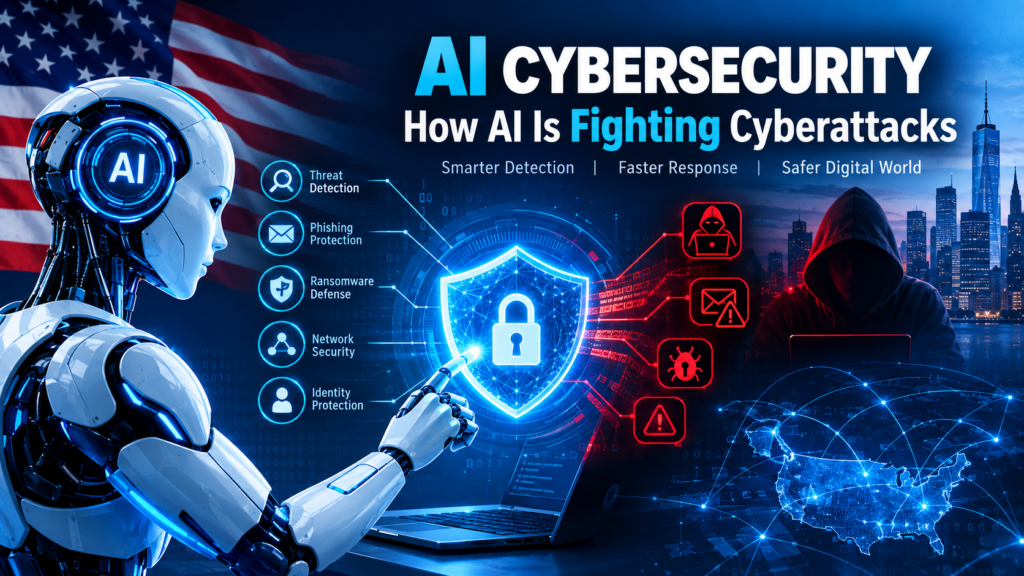
AI and Phishing Protection
Phishing is one of the most common ways attackers attempt to steal passwords, financial information, or personal data.
A phishing message may appear to come from:
- A bank
- An employer
- A delivery company
- A social media platform
- A government agency
- A friend or colleague
Modern phishing messages can look extremely convincing.
AI can analyze emails and messages for suspicious characteristics, including unusual language, links, sender behavior, domain information, and communication patterns.
For example, an AI security system may identify a message that looks like it came from a company’s executive but was actually sent from a suspicious domain.
AI can then flag the message before an employee clicks the malicious link.
AI in Ransomware Defense
Ransomware attacks can lock organizations out of their own files and systems.
Attackers typically demand payment in exchange for restoring access.
AI can help detect ransomware by identifying unusual file activity.
Suppose hundreds of business files suddenly begin changing or becoming encrypted. An AI-powered security system may recognize this as abnormal behavior.
Depending on the security configuration, automated defenses could potentially:
- Isolate the affected device.
- Block suspicious processes.
- Disable a compromised account.
- Stop network communication.
- Alert the cybersecurity team.
The goal is to reduce the amount of time attackers have to cause damage.
AI for Network Security
Networks generate enormous amounts of information.
Every connection, login, application, and data transfer can potentially provide clues about suspicious activity.
AI can analyze network behavior and identify unusual patterns.
For example, if a device inside a company’s network suddenly begins communicating with an unusual external server and transferring large amounts of data, an AI system could flag the activity.
This can be particularly useful for detecting unauthorized access and potential data theft.
AI and Identity Protection
Passwords remain a major target for cybercriminals.
Attackers may use stolen passwords, credential stuffing, phishing, or brute-force techniques to gain access to accounts.
AI can help identify suspicious authentication behavior.
For example, a security system might consider:
- Login location
- Device information
- Login time
- Previous behavior
- Number of failed attempts
- Accessed resources
- User activity
If an account suddenly behaves very differently from normal, the system can increase security requirements or alert administrators.
This approach is sometimes called risk-based authentication.
AI Helps Security Teams Prioritize Threats
One major problem for cybersecurity professionals is alert overload.
Security systems can generate thousands of alerts. However, not every alert represents a serious attack.
Security teams need to determine which events require immediate attention.
AI can help rank alerts based on factors such as:
- Potential damage
- Suspicious behavior
- Affected systems
- User activity
- Historical attack patterns
- Threat intelligence
- Network activity
This allows security professionals to focus their attention on the most important incidents.
Instead of investigating every alert manually, analysts can use AI to narrow down the most urgent threats.
AI-Powered Automated Response
AI is not only useful for detecting threats. It can also support automated responses.
When a high-risk event is detected, an AI-powered security platform may be able to recommend or initiate actions such as isolating a device or blocking suspicious network traffic.
However, organizations must carefully control automated actions.
A security system that incorrectly identifies legitimate activity as malicious could disrupt business operations.
For this reason, many organizations use a combination of AI automation and human oversight.
AI and Threat Intelligence
Cybersecurity teams need information about emerging threats.
Threat intelligence can include information about:
- Malware campaigns
- Malicious domains
- Attack techniques
- Vulnerabilities
- Suspicious IP addresses
- Criminal infrastructure
- Phishing campaigns
AI can process large amounts of threat intelligence and identify connections between seemingly unrelated events.
For example, information about a suspicious domain, a malware sample, and unusual network traffic could be combined to help analysts understand a larger attack campaign.
AI Can Help Small Businesses Too
AI cybersecurity is not only for large corporations.
Small businesses are also attractive targets because they may have valuable information but fewer cybersecurity resources.
A small company may not have a large security operations team monitoring its systems around the clock.
AI-powered security tools can help automate some monitoring and detection tasks.
This can allow small businesses to improve their security without requiring a huge cybersecurity department.
For American small businesses that depend on online payments, cloud software, customer databases, and remote employees, AI-powered security can become increasingly valuable.
The Role of AI in Cloud Security
Cloud computing has transformed the way organizations store and process information.
Companies use cloud platforms for:
- Business applications
- Customer databases
- File storage
- Communication
- Data analytics
- Software development
- Remote work
But cloud environments also introduce security challenges.
AI can monitor cloud activity and identify unusual access patterns.
For example, if an account suddenly downloads an unusually large amount of sensitive information, an AI system could flag the event.
AI can also help organizations identify misconfigurations and suspicious access permissions.
AI Is Also Being Used by Cybercriminals
While AI provides powerful cybersecurity benefits, it can also be used by attackers.
Cybercriminals may use AI to create more convincing phishing messages, automate certain tasks, generate malicious content, or analyze potential targets.
This creates an ongoing technology race.
Defenders are using AI to improve security, while attackers are looking for ways to use technology to make their attacks more effective.
As AI becomes more advanced, cybersecurity professionals will need to continuously improve their defensive systems.
The Problem of False Positives
AI cybersecurity is not perfect.
Sometimes an AI system may identify legitimate activity as suspicious.
For example, an employee may suddenly travel to another country and attempt to access company systems. The activity could look unusual even though there is no attack.
If security systems generate too many false alerts, security teams may become overwhelmed.
Therefore, AI needs good data, appropriate configuration, continuous monitoring, and human expertise.
Privacy Concerns Around AI Cybersecurity
AI security systems often need access to large amounts of information to detect threats.
This can raise privacy concerns.
Organizations need to carefully consider:
- What data is being collected?
- How is the data stored?
- Who can access it?
- How long is it retained?
- Is sensitive personal information being analyzed?
- How are AI decisions being reviewed?
Strong cybersecurity should not come at the expense of responsible data protection.
Organizations should establish clear policies for how AI systems collect and process security information.
Human Experts Are Still Important
AI does not eliminate the need for cybersecurity professionals.
Instead, it can give security teams better tools.
Human experts are still needed to:
- Investigate complex incidents.
- Understand business risks.
- Make strategic decisions.
- Review AI-generated alerts.
- Respond to sophisticated attacks.
- Develop security policies.
- Manage cybersecurity systems.
The most effective approach is often a combination of artificial intelligence and human expertise.
AI can process information quickly, while humans can provide context and judgment.
The Future of AI Cybersecurity
The role of AI in cybersecurity is likely to grow significantly.
Future security systems may become better at understanding normal behavior, identifying sophisticated attacks, and automatically responding to threats.
AI agents may also assist cybersecurity teams by investigating alerts, gathering information, and recommending defensive actions.
Another important development will be the use of AI to predict potential threats before they become major incidents.
Instead of simply asking, “Has an attack happened?” cybersecurity teams may increasingly ask, “What attack is likely to happen next, and how can we prepare for it?”
This could move cybersecurity from a reactive model toward a more proactive approach.
How Businesses Can Prepare for AI-Powered Cybersecurity
Businesses interested in using AI for cybersecurity should start with strong security fundamentals.
Some important steps include:
1. Use Multi-Factor Authentication
Multi-factor authentication can provide an additional layer of protection even when a password is compromised.
2. Keep Software Updated
Security updates often fix vulnerabilities that attackers could exploit.
3. Train Employees
Employees should understand phishing, suspicious links, password security, and social engineering.
4. Monitor Network Activity
Organizations should monitor systems for unusual behavior and unauthorized access.
5. Protect Backups
Important data should be backed up securely so that organizations have recovery options after incidents such as ransomware.
6. Combine AI With Human Oversight
AI should support cybersecurity professionals rather than operate without appropriate controls.
7. Create an Incident Response Plan
Businesses should know what to do if a cyberattack occurs.
AI Cybersecurity for Everyday Internet Users
You do not have to work for a large company to benefit from AI-powered cybersecurity.
Consumers can also take basic steps to improve online security.
Use strong and unique passwords, enable multi-factor authentication, keep devices updated, and be cautious with unexpected messages and links.
People should also be careful about sharing personal information online.
AI-powered security features built into browsers, operating systems, email services, and security applications can provide additional protection, but users still play an important role.
Final Thoughts
Artificial intelligence is changing the cybersecurity industry by helping organizations analyze enormous amounts of information, detect unusual activity, identify malware, fight phishing, monitor networks, and respond to threats more quickly.
As cyberattacks become more sophisticated, traditional security approaches alone may not be enough for many organizations. AI can provide cybersecurity teams with the speed and analytical capabilities they need to deal with modern threats.
However, AI is not a magic solution. It can make mistakes, create privacy challenges, and potentially be used by cybercriminals as well.
The future of cybersecurity will likely depend on a combination of artificial intelligence, strong security practices, advanced technology, and human expertise.
For businesses and individuals in the United States and around the world, understanding AI cybersecurity is becoming increasingly important. The organizations that learn how to use AI responsibly while maintaining strong security fundamentals will be better prepared for the evolving digital threat landscape.
AI may not replace cybersecurity experts, but it is becoming one of the most powerful tools they have to fight cyberattacks.