Tech stocks news today showing AI-driven market growth, Wall Street, Nasdaq, and major technology companies.

AI Boom Drives Technology Markets Higher

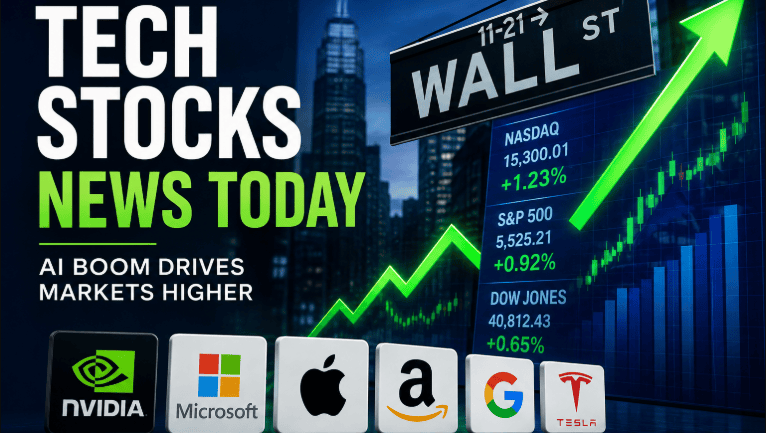
Technology stocks remain one of the biggest stories in global financial markets as investors continue to focus on artificial intelligence, semiconductor companies, cloud computing, and data-center infrastructure. In 2026, the rapid expansion of AI has created a powerful investment theme, with major technology companies receiving significant attention from investors around the world.
The latest market movement has once again highlighted the importance of technology stocks. Investors are watching companies involved in artificial intelligence and advanced computing as businesses continue to increase spending on digital infrastructure.
Technology Stocks Continue to Attract Investors
Technology stocks have become an important part of the global economy. From smartphones and cloud platforms to artificial intelligence and semiconductor manufacturing, technology companies are involved in almost every major industry.
Large technology companies have benefited from strong demand for digital services and AI solutions. Investors are particularly interested in businesses that can generate long-term growth from artificial intelligence.
The Nasdaq, which has a large concentration of technology companies, remains one of the most closely followed market indexes. Movements in major technology stocks can have a significant impact on overall market sentiment.
Artificial Intelligence Remains the Biggest Market Theme
Artificial intelligence continues to influence technology markets in 2026. Companies are investing heavily in AI systems, data centers, advanced processors, and cloud infrastructure.
The growth of generative AI has created new opportunities for semiconductor manufacturers, software companies, cloud providers, and networking businesses. Companies are competing to develop faster and more efficient systems capable of handling increasingly complex AI workloads.
This growing demand has also created opportunities for businesses that provide the infrastructure required to operate AI systems.
Investors are therefore paying close attention to AI-related companies when evaluating the future direction of technology stocks.
Semiconductor Stocks Benefit From AI Demand
Semiconductor companies are among the biggest beneficiaries of the AI boom. Advanced chips are essential for training and operating modern artificial intelligence systems.
Companies producing graphics processing units, processors, memory chips, and networking components are seeing increased interest as technology businesses expand their AI infrastructure.
Nvidia remains one of the most closely watched semiconductor companies because its processors are widely used in AI data centers. Other chipmakers are also working to capture a share of the growing market.
The semiconductor industry is increasingly important because AI development requires enormous computing power. As AI models become more advanced, demand for high-performance chips could continue to increase.
Nvidia Remains at the Center of the AI Market
Nvidia has become one of the most important companies in the artificial intelligence ecosystem.
The company designs advanced processors used by technology businesses, cloud providers, research organizations, and data centers. Its products are particularly important for training and running AI models.
Because of Nvidia’s position in the AI hardware market, investors frequently use the company’s financial performance as an indicator of broader AI demand.
Strong demand for AI infrastructure can support Nvidia and other semiconductor companies. However, investors also need to consider valuation and competition. Expectations for AI companies are already high, meaning future growth may need to remain strong to justify current market valuations.
Cloud Computing Companies Expand AI Services
Cloud computing is another major area benefiting from artificial intelligence.
Large cloud providers are investing billions of dollars in data centers and computing infrastructure. These companies allow businesses to access powerful computing resources without building their own large-scale infrastructure.
AI services are increasingly being integrated into cloud platforms. Businesses can use these services for data analysis, automation, customer support, software development, content creation, and many other applications.
As companies adopt AI, demand for cloud computing resources could increase. This creates another potential growth area for technology investors.
Data Centers Become More Important
The rapid growth of artificial intelligence has increased demand for data centers.
AI applications require significant computing power and electricity. Data centers provide the physical infrastructure necessary to operate large AI systems.
Technology companies are therefore investing heavily in new facilities, advanced cooling systems, networking equipment, and energy infrastructure.
This trend has created opportunities beyond traditional technology companies. Businesses involved in data-center construction, power generation, cooling technology, and networking equipment are also becoming part of the wider AI investment story.
Interest Rates Can Affect Technology Stocks
While AI remains a major driver of technology markets, interest rates continue to play an important role.
Technology stocks are often considered growth investments. Their valuations can be particularly sensitive to changes in interest-rate expectations.
When interest rates are expected to decline, investors may become more comfortable paying higher valuations for companies with strong future growth potential.
On the other hand, rising interest rates can put pressure on growth stocks because future earnings become less attractive when discounted at higher rates.
For this reason, investors following tech stocks news should monitor both corporate earnings and Federal Reserve policy.
Nasdaq Remains a Key Market Indicator
The Nasdaq Composite is one of the most important indicators for technology investors.
Because the index includes many large technology and growth companies, its performance can provide insight into investor confidence in the technology sector.
When major technology stocks rise, the Nasdaq can receive significant support. However, weakness in a few large companies can also put pressure on the index.
Investors are therefore watching the performance of major technology businesses closely as they evaluate the broader market.
Global Technology Markets Are Growing
The technology investment trend is not limited to the United States.
Asian markets are also benefiting from the growth of artificial intelligence and semiconductor demand. South Korea, Taiwan, China, and Japan are home to important technology and manufacturing companies that contribute to the global semiconductor supply chain.
South Korean chipmakers, for example, play an important role in memory technology. Taiwan is also a major center for semiconductor manufacturing.
As AI adoption expands globally, demand for chips and related technology infrastructure could create opportunities across multiple markets.
Risks Facing Technology Stocks
Despite the strong growth potential, technology stocks also face several risks.
One major concern is valuation. Some AI-related companies have experienced significant increases in their market values. If earnings fail to meet investor expectations, their stock prices could experience sharp declines.
Competition is another important factor. The technology industry changes quickly, and companies must continue investing in research and development to remain competitive.
Regulation could also affect the AI industry. Governments around the world are developing rules related to artificial intelligence, data privacy, cybersecurity, and digital platforms.
Energy demand is another issue. AI data centers require large amounts of electricity, creating challenges for companies attempting to expand their computing infrastructure.
What Investors Should Watch
Investors following technology stocks should focus on several important factors.
Corporate earnings will remain one of the most important indicators. Strong revenue and profit growth can support higher valuations, while disappointing results can create selling pressure.
AI infrastructure spending is another important factor. Investors want to know whether companies will continue increasing their budgets for AI chips, data centers, and cloud services.
Interest-rate expectations should also be monitored. Changes in Federal Reserve policy can influence technology stocks and broader financial markets.
Finally, investors should watch consumer and business demand. Technology companies need customers to continue purchasing their products and services in order to maintain long-term growth.
The Future of Tech Stocks
The long-term outlook for technology stocks will depend heavily on how artificial intelligence develops.
AI has the potential to transform industries including healthcare, finance, manufacturing, transportation, education, retail, and cybersecurity. If businesses successfully use AI to reduce costs and increase productivity, technology companies could benefit from sustained demand.
However, the market will eventually focus more on actual business results rather than expectations. Companies that can turn AI investment into sustainable revenue and profits may have an advantage over businesses that rely mainly on future promises.
This means investors may increasingly distinguish between companies with strong AI fundamentals and companies benefiting primarily from market enthusiasm.
Conclusion
Technology stocks remain one of the most important areas of the global financial market. Artificial intelligence, semiconductor demand, cloud computing, and data-center expansion are creating new opportunities for technology companies and investors.
Nvidia and other semiconductor businesses remain central to the AI infrastructure story, while cloud providers and data-center companies are expanding their services to meet growing demand.
At the same time, investors need to consider risks including high valuations, competition, interest rates, regulation, and the enormous cost of building AI infrastructure.
As artificial intelligence continues to develop, tech stocks news will remain closely connected to the broader global economy. Investors will be watching corporate earnings, AI spending, semiconductor demand, and interest-rate policy to determine whether the current technology boom can develop into sustainable long-term growth.



Latest News