
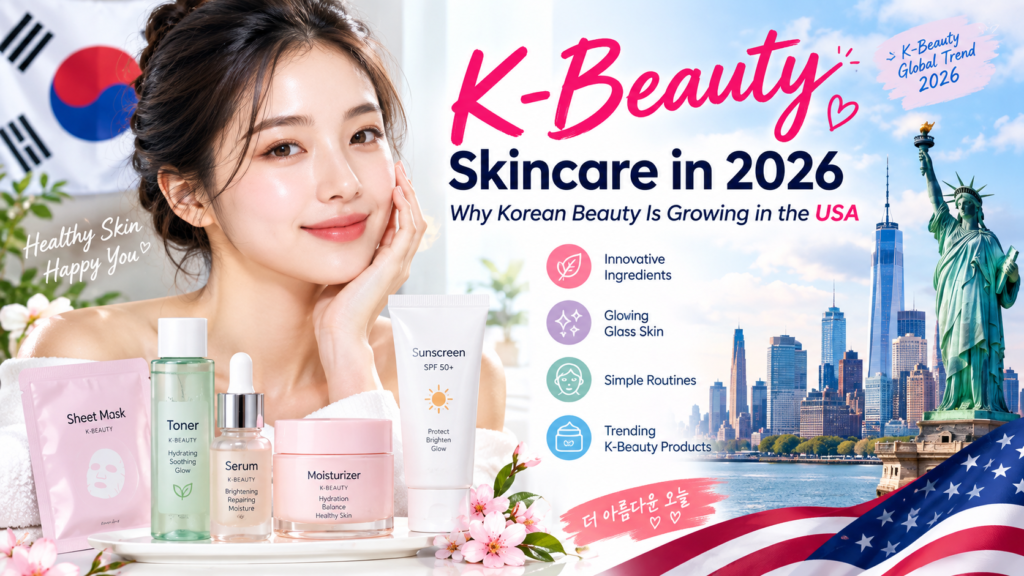
Korean beauty, commonly known as K-Beauty, has become one of the biggest influences in the global skincare industry. What once appeared to be a niche trend among beauty enthusiasts has now become a mainstream category in the United States.
In 2026, Korean skincare products are increasingly appearing in major American retailers, social media feeds, beauty routines, and online shopping carts. From hydrating toners and essences to sunscreen, sheet masks, serums, and innovative treatment products, K-Beauty is changing how many Americans think about skincare.
The growth is not happening by accident. Korean beauty brands have combined innovative ingredients, attractive product textures, affordable pricing, social media marketing, and a strong focus on healthy-looking skin.
According to Circana, K-Beauty brands in U.S. prestige retail grew by 23% in dollar sales and 24% in units during the first quarter of 2026. Skincare accounted for the majority of sales and essentially all of the category’s net gains.
So why is Korean skincare growing so quickly in America, and what makes K-Beauty different?
Let’s take a closer look.
What Is K-Beauty?
K-Beauty is a broad term used to describe Korean beauty products, routines, ingredients, and skincare philosophies.
Korean skincare has traditionally emphasized maintaining healthy-looking skin rather than relying only on heavy makeup to cover imperfections.
A typical K-Beauty approach may focus on:
- Hydration
- Skin barrier support
- Gentle cleansing
- Sun protection
- Consistent skincare
- Layering lightweight products
- Preventative skincare
- Innovative ingredients
K-Beauty is also known for introducing American consumers to products and ingredients that were not always common in mainstream Western skincare.
Sheet masks, essences, snail mucin, cushion cosmetics, fermented ingredients, lightweight sunscreens, and pimple patches are examples of products that helped Korean beauty gain international attention.
Why Is K-Beauty Growing in the USA?
There isn’t one single reason behind the growth of Korean skincare in America.
Instead, several trends are working together.
1. American Consumers Want Healthy-Looking Skin
One of the biggest changes in beauty culture is the shift away from covering the skin toward improving the appearance and condition of the skin itself.
Many consumers now prefer a natural, hydrated, glowing complexion.
This has created an environment where skincare products can become just as important as makeup.
K-Beauty fits naturally into this movement because many Korean brands focus heavily on hydration, skin texture, barrier care, and daily protection.
2. Social Media Is Driving K-Beauty Discovery
TikTok, Instagram, YouTube, and other social platforms have played a major role in introducing Korean skincare to American consumers.
A product can become popular after a creator demonstrates how it works, explains an ingredient, or shows a before-and-after skincare routine.
K-Beauty is especially suitable for social media because many Korean products have:
- Unique packaging
- Interesting textures
- Unusual ingredients
- Satisfying application videos
- Short demonstration formats
- Visually appealing results
Circana reports that Korean heritage brands have a particularly strong presence among leading skincare brands on TikTok, helping amplify K-Beauty’s influence.
Instead of discovering a product through a traditional beauty advertisement, many younger American shoppers now discover products through short-form videos and creator recommendations.
3. K-Beauty Is Moving Into Mainstream Retail
Another major reason for K-Beauty’s growth is accessibility.
American consumers no longer have to rely exclusively on specialty websites or international sellers to find Korean skincare.
Major retailers are increasingly adding Korean beauty brands to their selections.
In August 2026, Sephora announced the launch of 19 Olive Young-curated Korean beauty brands across more than 500 U.S. stores and Sephora.com.
This type of retail expansion makes Korean skincare much easier for American consumers to discover, compare, and purchase.
When a beauty category moves from niche online stores to major retail shelves, it can reach a much larger audience.
4. Innovation Is a Major K-Beauty Advantage
Korean beauty brands are known for experimenting with new formulas, textures, packaging, and product formats.
Instead of simply creating another traditional moisturizer or cleanser, brands often introduce products that feel different from what consumers have used before.
Examples include:
- Essence toners
- Ampoules
- Hydrogel masks
- Overnight masks
- Toner pads
- Pimple patches
- Lightweight sunscreens
- Capsule-based formulas
- Spicule skincare
- PDRN-inspired products
In 2026, the K-Beauty industry is also becoming more science-focused. Circana notes that Korean brands are increasingly emphasizing biotech-powered ingredients, dermatological validation, and skin-barrier health.
This combination of innovation and skincare science is helping Korean brands attract consumers who want more than attractive packaging.
5. The Traditional 10-Step Routine Is Changing
When many Americans first discovered K-Beauty, the famous “10-step skincare routine” received a lot of attention.
However, modern K-Beauty is becoming more flexible.
Consumers are increasingly interested in simple routines that contain fewer products but focus on effective ingredients and specific skin concerns.
This is important because complicated routines can be expensive and time-consuming.
Modern K-Beauty can be much simpler:
Cleanser → Treatment/Serum → Moisturizer → Sunscreen
Consumers can add products such as toner, essence, or masks depending on their individual needs.
This simplified approach makes Korean skincare more approachable for beginners.
Popular K-Beauty Ingredients in 2026
One reason Korean skincare attracts attention is its ingredient-focused approach.
Snail Mucin
Snail mucin became one of the best-known K-Beauty ingredients internationally.
It is commonly used in skincare products designed to support hydration and improve the appearance of skin texture.
Its popularity helped introduce American consumers to unconventional skincare ingredients.
Centella Asiatica
Centella asiatica is another popular ingredient in Korean skincare.
It is commonly associated with soothing and calming skincare products, particularly those designed for sensitive or irritated-looking skin.
Niacinamide
Niacinamide is not exclusive to Korean skincare, but it is widely used in K-Beauty formulas.
It can be found in serums, toners, moisturizers, and other products targeting concerns such as uneven-looking skin tone and excess oil.
Rice-Based Ingredients
Rice has a long history in Korean beauty traditions and continues to appear in modern skincare products.
Rice-based formulas are often marketed around brightening, hydration, and improving the appearance of skin texture.
Ginseng
Ginseng is another traditional Korean ingredient that has been incorporated into modern beauty products.
It is often used in skincare designed around revitalizing and nourishing the appearance of the skin.
K-Beauty Trends to Watch in 2026
K-Beauty is not standing still. Several trends are shaping the category this year.
Glass Skin 2.0
The original glass-skin trend focused heavily on an extremely glossy and dewy complexion.
In 2026, the idea is evolving.
The newer approach emphasizes healthy-looking, hydrated, smooth, and bouncy skin without necessarily requiring an extremely shiny finish.
This creates a more practical everyday look.
Skin Barrier Care
Skin-barrier-focused skincare continues to attract attention.
Instead of constantly using strong active ingredients, consumers are becoming more interested in maintaining comfortable, hydrated, resilient-looking skin.
This fits well with the growing demand for gentle daily skincare.
Slow Aging
Another emerging concept is “slow aging.”
Rather than focusing only on aggressive anti-aging treatments, this approach emphasizes long-term skincare habits such as:
- Sunscreen
- Hydration
- Antioxidants
- Gentle cleansing
- Barrier support
- Consistent skincare
The idea is to maintain healthy-looking skin over time instead of waiting for visible concerns to become more noticeable.
PDRN and Advanced Ingredients
PDRN-inspired skincare has received significant attention in the Korean beauty market.
PDRN is associated with professional Korean aesthetic treatments, and skincare companies are increasingly developing topical products inspired by these treatment trends.
However, consumers should distinguish between professional procedures and cosmetic skincare products. Marketing claims can vary significantly between products.
Toner Pads
Toner pads are another convenient format gaining attention.
Instead of applying toner with cotton rounds or hands, consumers can use pre-soaked pads directly on the skin.
Some products are also designed to be used briefly like mini sheet masks.
Scalp-First Beauty
Korean beauty innovation is also expanding beyond facial skincare.
Scalp care is becoming increasingly important, with products designed around cleansing, hydration, and maintaining a healthy-looking scalp.
This reflects a broader movement toward treating the scalp as part of the overall beauty routine.
Why American Gen Z and Millennials Like K-Beauty
Younger American consumers have played an important role in the growth of Korean skincare.
Gen Z and Millennials are particularly comfortable discovering products through social media.
Instead of relying exclusively on traditional advertising, they may research:
- TikTok reviews
- YouTube tutorials
- Instagram content
- Reddit discussions
- Influencer recommendations
- Ingredient explanations
- Customer reviews
K-Beauty works especially well within this environment because products often have distinctive stories.
An ingredient, texture, routine, or product format can become the subject of a viral video.
This creates a powerful cycle:
Discovery → Social Media Interest → Product Trial → Reviews → More Discovery
K-Beauty Is More Than Skincare
Although skincare is currently the strongest part of the K-Beauty category, Korean beauty also includes makeup and haircare.
Korean makeup is known for styles such as:
- Natural-looking foundation
- Soft blush
- Gradient lips
- Glossy lips
- Soft eyebrows
- Lightweight complexion products
However, in 2026, skincare is still the major growth engine for K-Beauty in the United States.
Circana’s 2026 data shows skincare accounting for most K-Beauty sales and essentially all of the category’s net gains in prestige retail.
Is K-Beauty Better Than Western Skincare?
It would be inaccurate to say that K-Beauty is automatically better than Western skincare.
Both Korean and Western brands produce excellent products, and the best choice depends on a person’s skin type, concerns, budget, ingredients, and preferences.
The biggest advantage of K-Beauty may be its approach to product development.
Korean brands often focus heavily on:
- Lightweight textures
- Hydration
- Layering
- Ingredient innovation
- Daily skincare
- Product experience
Western brands can offer different strengths, including extensive clinical research, established active ingredients, and dermatologist-developed products.
Consumers should judge products individually rather than assuming that a product is effective simply because it is Korean.
How to Build a Simple K-Beauty Routine
You don’t need ten products to experience Korean skincare.
A beginner can start with a simple routine.
Morning Routine
Step 1: Gentle Cleanser
Start with a cleanser that removes overnight oil and buildup without leaving the skin feeling excessively dry.
Step 2: Hydrating Toner or Essence
This step is optional but can add hydration.
Step 3: Serum
Choose a serum based on your main skincare goal.
Step 4: Moisturizer
Use a moisturizer appropriate for your skin type.
Step 5: Sunscreen
Sunscreen should be one of the most important parts of a daytime routine.
Evening Routine
Step 1: Cleanser
Remove sunscreen, makeup, oil, and daily buildup.
Step 2: Toner or Essence
Add hydration if needed.
Step 3: Treatment
Use a targeted serum or treatment based on your skincare needs.
Step 4: Moisturizer
Finish with a moisturizer to help maintain hydration.
This simple routine can be expanded later if your skin tolerates additional products.
What Should You Look for When Buying K-Beauty Products?
With hundreds of Korean beauty products available in the United States, choosing the right product can be overwhelming.
Instead of buying something simply because it is viral, consider:
Your Skin Type
Determine whether your skin is oily, dry, combination, normal, or sensitive.
Your Main Concern
Focus on one or two major goals rather than purchasing products for every possible concern.
The Ingredient List
Look beyond marketing claims and check the actual ingredients.
Your Existing Routine
Adding five new products at once makes it difficult to know what works or causes irritation.
Product Reviews
Look for reviews from people with similar skin concerns.
Retailer Reputation
Purchase from reputable retailers and authorized sellers when possible.
The Future of K-Beauty in America
The growth of K-Beauty in the United States appears to be more than a short-lived social media trend.
The category is increasingly supported by mainstream retail distribution, social media influence, product innovation, and consumer interest in skincare.
The expansion of Korean beauty into major U.S. retailers is particularly important because accessibility can turn online curiosity into repeat purchases.
At the same time, the category is evolving.
The future of K-Beauty is likely to focus less on simply promoting a large number of products and more on:
- Effective formulations
- Skin-barrier health
- Science-backed ingredients
- Simplified routines
- Advanced skincare technology
- Personalized skincare
- Sustainable packaging
- Multifunctional products
The combination of Korean innovation and American consumer demand could continue influencing the global beauty industry.
Final Thoughts
K-Beauty skincare has changed dramatically since Korean beauty first became popular in the United States.
What started with products such as sheet masks, BB creams, essences, and snail mucin has developed into a major beauty category with growing mainstream retail distribution.
In 2026, Korean skincare is gaining even more attention because it combines innovation, skincare-focused routines, attractive product formats, social media appeal, and growing retail accessibility.
The U.S. market is becoming particularly important for Korean beauty brands. Recent industry data shows strong K-Beauty growth, while major retailers are expanding their Korean beauty selections.
For American consumers, the biggest lesson is simple: you don’t need to follow every viral trend or use a complicated 10-step routine. A well-chosen cleanser, treatment, moisturizer, and sunscreen can form the foundation of an effective skincare routine.
As K-Beauty continues to evolve, its influence on American skincare is likely to become even stronger.
K-Beauty is no longer just a trend from Seoul—it has become an important part of the modern U.S. beauty conversation.